Winsome in White: Wedding Dress Fetish

A strapless white Betsey Johnson dress that makes me shriek

When I attended a cakesitting party, I theorized that perhaps the spark of lust some people feel from destroying a cake materializes because we put so much time and effort and emotional energy into cakes. Not just the making of them, but also the planning for them, presenting them, eating them. They’re the centerpiece of a traditional birthday party, and to destroy something so precious and so highly celebrated is an almost unfathomable taboo. It’s why, you’ll note, many big showy “Oh no!!” moments in movies culminate in a cake being tragically (and comically) destroyed.

Around the same time, I started wondering whether this taboo of destroying highly celebrated objects could extend to other types of celebrations. So, naturally, I typed “wedding dress fetish” into Google, thinking: what could be a more celebrated object than that?

Currently, that phrase brings up 41 results. In those results, you’ve got your brides merely expressing extreme enthusiasm about their dresses, sure, but you’ve also got an Experience Project page of men professing their lust for wedding dresses, porn clips of women giving blowjobs in floofy white frocks, and a review of a mystery novel about a serial killer who dresses all his victims in wedding gowns. It’s often said that humans can and will fetishize anything and everything you can think of, and this is no exception. One fetishist writes that a wedding dress is “the ultimate in femininity and the most ultimate dress anyone can own.” I can’t argue with that, except to add that the femininity being referred to here is, of course, a capitalist and conventional form of that gender expression, tied up in many different axes of historical oppression.

More broadly, some people have a “bride fetish” or a “bridal fetish,” which might focus on the dress but also might focus on the other trappings of a woman being wed: the white lingerie under the dress, the flawless makeup, the veil, the unattainability, the supposed virginity, or any number of other things. I’m most interested in the dress as a fetish object, though, especially after having read Laurie Essig’s book Love, Inc. where she dissects the vast psychological baggage we’ve placed on the wedding dress as a symbol. It’s right up there with crosses and the human heart in terms of the importance we heap onto it.
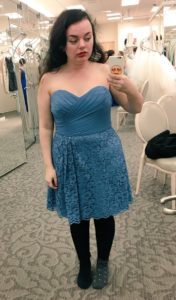
I spent some time in a bridal shop a couple years ago when I joined my friend’s wedding party. While I was trying on bridesmaid dresses – which are pretty much designed to make the wearer look unremarkable and plain, but in a pretty way – my friend kept swanning in and out of the dressing room in one gorgeous gown after another, commanding the room. I teared up almost every time she emerged in a new dress, because the effect of seeing someone you love – or even someone you hardly know! – in a dress that culturally weighted is powerful.

I didn’t experience that feeling as sexual, but I can easily see how someone could. Swathing yourself or a loved one in white tulle and satin could be a way of accessing what’s supposed to be the best day of your life, a day when you look and feel gorgeous, a day that we all winkingly acknowledge will probably end in romantic sex. It’s a day when everyone stares at you, when you’re the center of attention but no one gets mad at you for it, when you make promises that are supposed to be binding. There’s a lot in there that overlaps psychologically with concepts like exhibitionism and voyeurism, dominance and submission, and (especially when you factor in the corsets and high heels) sadism and masochism. It’s no wonder some people fixate on weddings and their trappings in a distinctly sexual way.

Apparently sometimes bridesmaids try on wedding gowns when the bride-to-be does, because “When in Rome” and all that – but I didn’t, when I was in that bridal boutique with my pal. It would’ve felt inappropriate to steal her thunder, but also there was something powerfully sacred about these dresses in my mind. I didn’t want to try one on until I had “earned” the right by getting engaged and actually being a bride-to-be, rather than just playacting as one. I knew seeing myself in a white gown would unleash a torrent of feelings I wasn’t ready to feel. So I zipped myself into my meek blue cocktail dress and tucked that desire away for another day.

I hope someday I have sex in a wedding gown, whether or not I actually got married that day, because I imagine there’s just nothing else quite like it. What else could be as decadent – besides sitting on a beautiful chocolate cake?


This post was sponsored. As always, all writing and opinions are my own.
10 Ways Sex & Hookup Websites Can Be Safer For Women

For as much as I talk about dating sites and the hours of amusement they’ve brought me, I don’t actually think they’re that great. They’re too often full of creeps and trolls, seeking to offend and harass more than they’re seeking actual dates or hookups. The situation is dire. Even at times when I’ve been highly motivated to find dates and/or sex on these sites, sometimes I felt cockblocked by my insidious fears about getting catfished or doxxed – or worse, assaulted on a date. It doesn’t have to be this way!

Since so many dating sites and apps are subpar in this area, I’ve put together these 10 suggestions for how these companies can make their services safer and more appealing for women. (A lot of this applies to people other than women as well – anyone vulnerable and/or marginalized, potentially – but I’m a woman so that’s the perspective I’m coming from.) I wish more sites would take these ideas into account!

Comprehensive blocking. I’ve yelled about this before, but… please, please, Hookup Websites, give us a decent blocking feature. You should be able to block someone before you match with them, not just once you’ve already matched (*cough* fuck you Tinder), and once you’ve blocked someone, they should be unable to see any aspect of your profile ever again. This isn’t even that difficult to implement and would make lots of people feel much safer.

A reporting feature that works. If someone is sending unsolicited dick pics, or misogynist screeds, or using pick-up artist tactics, or (god forbid) attacking people on dates, there should be an option to report them on the app or website and have them investigated by a human person (not a robot!) from the platform. If need be, their profile should be pulled. Letting creeps run wild on your site is a surefire way to make women nervous about using it.

Functional filtering. Beyond just making it easier to find compatible dates, this feature can also prevent a lot of scary or annoying situations. I simply don’t want non-feminists to be able to view my profile, let alone interact with me. I’m not saying everyone who rejects the feminist label is dangerous, but certainly in many cases their ideologies are (who the fuck doesn’t want gender equality in this day and age?!), so I just want them gone from my digital life. Nip that “friendly debate” about my personhood in the bud. Byeee.

Identity verification. Okay, this is a controversial one, because some people are understandably skittish about having to upload their ID to a dating site. Some folks even get angry when asked to do so. But I think, provided the data was kept private and managed responsibly (i.e. maybe deleted altogether after verification was complete), it would be worthwhile to make sure people actually are who they’re claiming to be. The internet makes it all too easy to catfish folks, and that’s not cool. Plus I think people would behave better on a platform if they knew it had all their info on file.

Vouching. If you’ve had a good date with someone, maybe you could leave them feedback in the form of a review, like on Yelp, or a rating, like on Uber. Of course, this feature is somewhat objectifying and would likely be abused – I can imagine shitty men leaving bad feedback for women who didn’t “put out” after their date bought them dinner, for example – but it could be useful for shunning creeps.

Taking privacy seriously. I had no idea, for example, when I linked my Instagram account with my Tinder account, that matches and even non-matches would be able to click through to my IG profile and thus immediately learn everything about me; I thought this feature would just show my pictures on my profile. Some dating apps use geolocation, some force you to disclose your school or your workplace, some make you use your real name… All of these “features” are problematic because they put you at risk if someone decides to track you down. Let users decide how much they want to disclose!

Gender self-identification tools. I hear lots of different things from my trans, non-binary, and genderqueer friends about how they wish gender worked on dating sites. However, the common thread seems to be that they wish there were more options rather than less, even if they wouldn’t actually use the options provided. Not every trans woman will feel comfortable disclosing on her profile that she’s trans, for example (especially since doing so often brings on harassment and even violence), but some trans folks prefer to air that stuff upfront so they don’t have to deal with it later. Dating sites should allow for this. In doing so, they’ll also normalize gender disclosure for everyone, not just trans people.

Tools for setting expectations. Many dating sites already have this – but many don’t, and it’s weird! You should always be able to indicate whether you’re looking for something casual, something more serious, either, or something in between. This can help prevent some of the tension that arises when you go on a date with someone whose dating goals end up being different from yours.

Clear community guidelines. I’d rather they be too harsh than too lenient. No unsolicited sexual media, no pick-up tactics, no racism, no sexism, no homophobia, no transphobia, that kind of thing. Setting these boundaries clearly and publicly, and standing by them, would make a company seem more trustworthy to me, and thus more worthy of my patronage.

Investment in sexual health and anti-sexual violence causes. Okay, this one’s more abstract and indirect. But I would definitely trust a hookup platform more if it had made tangible monetary contributions to these causes. Being publicly sex-positive and feminist isn’t just a marketing tactic; it helps establish a culture on the site, and shows abusers and misogynists that they’re not welcome.

What safety features do you wish more dating sites had?


This post was sponsored. As always, all writing and opinions are my own.
Sex With an Ex: Good Idea, or Worst Idea?

I’ve never had sex with an ex. This experience seems to be common, and being as sentimental and stubborn as I am, it seems like something I would do – but I never really have. Apart from one ill-advised encounter with an ex-FWB in a sweaty closet at a Pride party, I’ve never gone back to once again fuck someone I had previously decided I wasn’t going to fuck anymore.

Oh, I’ve certainly thought about it. Whenever someone dumps me, I walk around in a haze of regret for at least a few weeks, daydreaming about running into my ex in public while looking absolutely scintillating, and earning an invitation back to their place for comfortingly familiar sex that will inevitably lead us back into a comfortingly familiar relationship. But this never happens, and in the long run, I never really want it to.

Having sex with your ex is playing with fire. If you broke up, there was always a reason – and if you feel the desire to find ’em and fuck ’em again, it’s worth pondering: what was the reason you broke up, and is that reason still relevant?

It may not be. For example, I’ve broken up with people because I was in love with someone else and it was messing up my relationship, or because they were dating someone who decided they didn’t want to be polyamorous. Both of these are circumstantial roadblocks: they posed a problem at the time but may well have melted away in the intervening months or years. These are people with whom I might be tempted to rekindle things if I ever bumped into them on the subway or at a party, because – why not? If the attraction and compatibility are still there but the problems aren’t, what’s stopping us from giving it another go?

But that’s not why most breakups happen. Most breakups happen because you came up against some kind of fundamental incompatibility, or there was a big betrayal, or you just weren’t feelin’ it anymore. In those situations, it’d be tougher to justify a redo. Sure, your ex’s body and mind might still thrill you, or inspire a nostalgic frisson, but pursuing that half-extinguished spark is often more trouble than it’s worth.

Of my 30 lifetime sexual partners, 28 are people I’m no longer sleeping with. Of those 28, 10 are people I would happily fuck again if the opportunity presented itself – but that’s unlikely to happen. 5 are people I would consider fucking again, but we would have to have some heavy discussions and one or both of us would need to make some serious amends before I would feel comfortable jumping back into things with them. The remaining 13 are people I just don’t have any desire to be intimate with ever again – either because they hurt me too badly, or I’ve lost all attraction I once felt for them, or we just aren’t sexually compatible, or all of the above. I’d be curious to know what your ratio is, if you feel like sharing!

So, is sex with an ex a good idea? I think it’s a situation where you’d have to have a lot more pros than cons to justify even attempting it. Sex with someone who knows your body, who you feel comfortable around, and who you don’t have to explain yourself to is very tempting – but I think, in most cases, it’s not worth the complications and tricky feelings it could bring up. Whether I dumped them or they dumped me, I’d be verrrry hesitant to get back in bed with an ex. That’s not to say you should never do it, but be careful with your heart, okay?


This post was sponsored. As always, all writing and opinions are my own.

Why Sex Skills Are More Important Than “Sex Moves”

Sex guides that focus on particular “moves” have entertained me for years. I read them like they’re porn, and in a way, they are. “Swirl your tongue in circles around the clit.” “Stroke the G-spot firmly with two fingers until you feel it swelling.” “Lick the frenulum while cupping the balls.” They’re so vivid and visceral, they conjure up images with almost as much immediacy as porn. So I’d be lying if I said I’ve never jerked off to an article with a clickbait-y title like “10 Easy Tricks For Getting Her Off” or “Blow His Mind With These Foolproof Blowjob Moves.”

But, also like (mainstream) porn, these guides don’t teach you much about how to have actually good sex with actual humans. They try to pin sex down, like it’s a recipe or a location on a map, without acknowledging how variable and fluid it can be in reality.

One of the things that struck me most about Ian Kerner’s classic oral sex bible She Comes First is that it’s absolutely chock full of “moves.” He groups these manoeuvres together into what he calls “routines,” which are broken down into “stages”; he offers estimates on the proper amount of time to spend on each. One such section advises, for example, “Alternate vertical strokes of the tongue with horizontal strokes. On vertical strokes, try to just graze bottom of the clitoral head without fully hitting it. Focus on brushing the head on horizontal strokes. For every five vertical, do one horizontal.” Seeing a problem here?

These “routines” are a great starting point for someone who’s never eaten pussy before and has no idea how to begin, but to treat them as gospel is to miss the point of sex entirely. So much of good sex is about paying attention to your partner’s body and their responses and adjusting your approach accordingly. This give-and-take, back-and-forth interplay is the intimacy, the connection, the dynamism, the fun of good sex. Without it, you might as well be fucking a robot or a computer: input x and you’ll get y.

One of the most popular and well-known “sex moves” is the one where you lick the letters of the alphabet on someone’s clit, starting with A and working your way through to Z. However, used properly, this technique is really more about gathering information than it is about getting someone off. By licking the alphabet, you’ll be trying out a wide variety of different types of tongue strokes – different directions, placements, and lengths – and so you’ll learn a lot, very quickly, about how your partner likes their clit touched. At least, you will if you’re paying attention, rather than trying to remember what letter comes next!

So, if “moves” aren’t important, what is? I think the answer is sex skills. Someone who knows a few recipes will effectively only be able to make those recipes, whereas someone who’s picked up culinary skills will be able to improvise a meal with basically any ingredients you throw at them. That’s how sex should be approached, I think: great sexual partners are not just great at the things they do but also great in the way they do them.

Some of the most important sexual skills are reading a partner’s body, taking feedback well, communicating your needs without being overly critical, and learning and remembering what particular partners like. There are also more physically-based skills, like staying in rhythm, fingerbanging with precision, taking a dick deep in your throat, and relaxing your muscles to take penetration. But I think the mental ones are more important, because once you have those, you’re much better equipped to work on everything else. You’ll have your partner(s) moaning your name – and you’ll know it’s because of you, not some guide you read on the internet.


Do you have any favorite “sex moves”? What do you think are the most vital sexual skills?


This post was sponsored. As always, all writing and opinions are my own.

5 Things Sex Toy Educators Should Never Do

I’ve been educating folks about sex toys for the better part of a decade, and as such, I’ve developed strong opinions about what people in my industry should and shouldn’t do. It’s a delicate line of work, one in which you constantly run the risk of fucking someone up (or fucking up their sex life, at the very least), so it’s important to be thoughtful about how you approach it. Here are 5 things I think sex toy educators should never, ever do…

Make assumptions

You might think you know the sexual orientation, genital configuration, or relationship style of someone who comes to you for advice, but unless they explicitly tell you, you don’t actually know any of that stuff. So don’t assume you do!

The best way to avoid making assumptions is to ask questions – though, of course, you have to “read the room” to figure out which questions are okay to ask. For example, if someone who appears to be a cis man asks me for help choosing a toy for masturbation, I might ask, “Do you mean a stroker, an anal toy, or something else?” Or if someone says they want a toy they can use with their partner, I might ask, “What kinds of toys does your partner like/want?” rather than assuming the person is straight or their partner is cis. I’ll also tend to avoid using gendered pronouns until the person I’m talking to does. You can really put someone off sex toys by making shitty assumptions, so how ’bout let’s not do that!

Recommend toys that will cause harm

We know that toys made of jelly, for example, leach phthalates and cause internal irritation for many people who use them, not to mention potentially worse side effects like endocrine disruption. It would be a bad move to suggest someone buy or use one of these toys, at least without heavily educating them on the risks they’d be taking on by doing so.

Of course, the reality of sex toy retail is that some people cannot afford or do not want to buy fancier toys that are body-safe, in which case our job as educators is to steer them in the right direction while also meeting them where they’re at. Hard plastic vibrators are usually body-safe and cheap, for example, and if someone wants a squishy toy without a silicone-level price tag, they might be content with a porous (not toxic) dildo that they use with a new condom every time to keep bacteria out. A partial solution is better than none at all.

Perpetuate oppressive beliefs

It’s bullshit that all men have higher sex drives than all women; that all women have vaginas and all men have penises; that there are only two genders; that buying a sex toy makes someone pathetic or lonely; that masturbation isn’t necessary or allowed if you’re in a relationship; that sex toys take your virginity; that penetrative sex toys stretch out your vagina; that your partner’s going to leave you for a sex toy; and that you’ll permanently lose sensation in your genitals if you use a vibrator. These are just some of the shitty myths that come up in sex toy education!

As an educator, it’s your job to be more neutral than dogmatic, and to put far more stock into science than myths. Teaching someone about sex is a powerful opportunity to untangle lots of damaging beliefs; it’s sacred and should be approached carefully!

Act inappropriately

While you might encounter lots of cute people in sex education work, it’s really not cool to hit on them, at least not in that teacher/student context. Later on, when you’re on more equal footing, an opportunity might arise to ask them out, etc. – but some educators won’t even do that! Wherever you draw your personal boundaries on this matter, I think it’s better they be too stringent than too loose.

I’ve had sex shop employees give me the flirty eyes, ask me overly personal questions, or even straight-up demand to know if I was single. Don’t be that guy!

Lay blame

A lot of people are really fucked up about sex. They might come to you knowing nothing or next-to-nothing about how sex toys work, the different types of toys, and what toys can and can’t do for their sexuality. It’s not their fault if their knowledge level is low; it’s the fault of our culture. That’s why educators’ work is so important.

In the movie High Fidelity, a record store employee, Barry (played by Jack Black), shames a customer for not owning a record Barry thinks he ought to own: “You don’t have it? That is perverse! Don’t tell anybody you don’t own fucking Blonde on Blonde!” Don’t be like Barry. Remember that everyone is just trying their best, and it’s not their fault they’re ill-informed about sex.

What other mistakes do you hate when sex toy educators make?


This post was sponsored by the folks at SexToyEducation.com. As always, all writing and opinions are my own.