Down Deep (A Hypnokinky Poem)

down deep i drop for you
so well down the well
and well i just don’t know
how deep i can go
i’m drifting drooping dropping
flowing floating finding
my way to that deepest place
so lost and lovely, listening
to your voice my guide my love
my tether and my terror
we are journeying together
to a spot at the centre of a spiral
feeling flummoxed, flustered, flushed
i flutter, or my eyelids do
they’re heavy now so heavy
that they do what eyelids do
and close without contention
so i let myself let go
and let you drag me deeper
with the wonder of your words
so rhythmic like a ride
over the rapids, over falls and drops
until i’m floating down the river
of my empty addled mind


Author’s note: I wrote this as part of the Smutathon!

Escort Echelons: What is the “Whorearchy”?

I think I first encountered the term “whorearchy” in a podcast hosted by Tina Horn. She’s done sex work in various forms and is thus, I would assume, intimately familiar with the ways people in that community can turn against each other, judge each other, and speak ill of each other. Porn performer Belle Knox says the whorearchy is the name given to the phenomenon in which “sex work segregates itself along perceived social and legal lines.” It is – like so many systems of (de)valuation and “respectability” in marginalized communities – a form of infighting, of internalized oppression, of people keeping each other down when they might instead lift each other up.

Though I’ve done very few forms of sex work, sparingly and sporadically, I have seen this dynamic in action. In sugar baby communities, for example, there’s often tons of hostility aimed at escorts and escort agencies, the implication being that sugar-dating is somehow classier than full-service sex work because it’s not directly transactional, even though… in most cases, it is. There are also phone-sex operators who disdain in-person sex work, escorts who think camming isn’t real sex work, and pro dommes who think their lack of genital contact with clients makes them better than service providers who do have sex with johns, just to name a few examples.

These squabbles remind me of the internalized misogyny displayed in, for instance, bookish brunettes claiming busty blondes are stupid and setting feminism back, or TERFy second-wave feminists insisting third-wavers are betraying the cause by embracing promiscuity and trans rights. This type of infighting mostly just encourages marginalized people to police each other’s behavior rather than banding together to take on their oppressors.

It’s worth noting, of course, that different types of sex work do come with different levels of risk, difficulty, and stigma. Street-based sex workers are particularly vulnerable to violence, for example, and racialized and/or disabled escorts face discrimination and mistreatment that white and/or able-bodied ones don’t. Acknowledging and understanding these differences is part of intersectionality: the feminist idea, coined by black feminist theorist Kimberlé Williams Crenshaw, that oppressed people (in this case, sex workers) all have different experiences based on their identities and the systems of oppression they face. However, someone having a different experience than you in the world doesn’t mean they have to be your adversary.

In fact, it’s been wonderful to see sex workers from various different areas of the field band together to fight against SESTA/FOSTA, the “anti-sex trafficking” laws that have seriously eroded sex workers’ rights, freedoms, and livelihoods. I’ve seen escorts and camgirls chatting online about the problems they face, pornographers boosting phone-sex operators’ tweets about their struggles, online findommes telling their audiences to donate to Red Light Legal. There have been stunning incidences of solidarity, because, as is so often the case, marginalized individuals are stronger together than splintered.

A while ago, an escort friend of mine asked if I wanted to come to a sex workers’ play party she was organizing. I was surprised: “I’m not really a sex worker,” I stammered, “I just, like, do cam shows and sell nudes and make amateur porn and sometimes sell my panties and I was a sugar baby once…” I was so used to having my sex work experiences diminished, or to feeling like I had to preemptively diminish them myself, because what I do isn’t “real” sex work. But here’s the thing: it is, even though it’s different from other types. I’ve seen more and more recognition in my online communities over the past few years that the whorearchy doesn’t serve anyone it comprises. Sex workers’ problems have gotten worse and the community is suffering more than it has for a long time (and it’s suffered a lot) – but sometimes it seems the internal landscape of the group is shifting for the better, even if only a little.

My friend smiled. “That totally counts! You should come!” I smiled, too.


This post was sponsored. As always, all writing and opinions are my own.

Should You Be Able to Rate & Review Sexual Partners?

I wrote this in high school but lots of it still rings true…

In 2013, a new app called Lulu was released which allowed female users to anonymously rate and review their male acquaintances, including friends, exes, and past hookups. The men were rated on a 10-point scale, for criteria like humor, manners, ambition, and willingness to commit.

There was immediately a media panic about it, with outlets referring to Lulu as “Sex Yelp” and speculating on what it portended about human relationships in the 21st century. Dating-app giant Badoo later acquired Lulu and shut down the ratings component of the app, but the question remained: is rating and reviewing sexual partners useful? And perhaps even more pressingly: is it ethical?

I’m sorry about the cissexism. We were young and shitty.

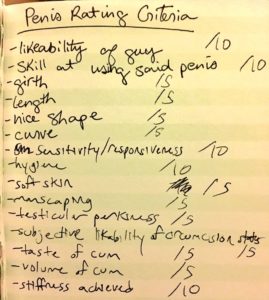
I thought about this again years later when a friend and I devised a rating scheme for penises we had known, featuring criteria like “hygiene,” “soft skin,” “taste of cum,” “testicular perkiness,” and so on. It seemed harmless to me at the time, a hilarious joke perpetrated while tipsy, but upon reviewing it in the light of day, I realized how objectifying it was. What I’d originally conceptualized as a tool for discussing sexploits with friends (“The dick I sucked last night was an 86 out of 100, can you believe?!”) now seemed like a process as cruel and dismissive as swiping through Hot or Not or scoring selfie-submitters on the “Am I Ugly?” subreddit. How could I call myself sex-positive and body-positive if I was literally assigning numerical scores to people’s anatomy? I couldn’t.

There are some cases where rating sexual partners seems fine, or even prudent. Sometimes clients offer public feedback about sex workers they’ve seen (check out USASexGuide for more on that), which can inform prospective johns’ decisions and drive clientele to service providers. There are also always backchannels where women and other marginalized people exchange notes on their dates and hookups with others in their community, warning friends away from abusers and boundary-crossers. These discussions are crucial for keeping people safe who would otherwise have trouble staying safe, because of the unfortunate ways our dating culture and sex work laws are set up. I don’t begrudge anyone for sharing info about “bad dates” and reading other people’s info of the same sort; sometimes these behaviors are the only recourse you have.

But rating people’s bodies and sexual skills is a different thing entirely. Sex is deeply personal, and sometimes embarrassing, and a lot of people have a lot of hangups about it; the same things can be said about our fallible human bodies. It seems unjustifiably cruel to rate people on these criteria in a venue as public as an app or a website, unless they’ve specifically solicited that feedback, like people do on “rate me” forums. (I often wonder if these people are suffering from low self-esteem, or discovering a sublimated objectification/humiliation kink, or both.) In a culture as sex-negative and body-critical as ours, you hardly need say anything at all to fuel someone’s deepest fears and insecurities. Even the most seemingly innocuous criticism can set off a spiral of self-hatred in those of us who are susceptible to this sort of thing, which is most of us.

So I can no longer justify rating and objectifying people (or penises) in the ways I used to. Eradicating sexual shame and encouraging self-love are two of my key goals, professionally and personally, and critiquing bodies and sexualities runs counter to these objectives. This is true not only for other people but for myself: the more you cast a critical eye on how other people look and what they’re doing in bed, the more you’ll tend to judge yourself in those areas as well, perhaps without even meaning to. These mental habits are dangerous, and insidious, and must be actively fought against to be extinguished.

Tell your best friend about last night’s mediocre hookup over drinks, if you like; write in your journal about genitalia that confounded you, if you must. But sharing these judgments online doesn’t really serve anyone, in my view, and it may even contribute to society-wide shame cycles. If you want to create a better world for humans who have sex, one of the best ways to start is to view everyone’s body and sexuality with the same compassion you’d hope they would extend to you.


This post was sponsored. As always, all words and opinions are my own.

25 Things to Do in the Fall

Yeah, I’ll say it: fall is the second-best season, after spring. (Don’t @ me.)

Now that it’s officially ~the cozy season~, I’m thinking about all my favorite ways to celebrate the dropping temperatures, shortening days, and yellowing leaves. Here are 25 fall-appropriate things to consider doing in the next few months…

Heat things up with temperature play. On the hottest summer days this year, my partner rubbed a giant ice cube all over my body as part of a surprisingly intense kink scene – but now that things are cooling down, we’ll likely get back into a perennial fave, wax play. All you need to get started is candles made specifically for wax play (they burn at a safer temperature than regular candles), a tarp or water-resistant sheet to keep wax off your bed, and a butter knife or credit card to scrape off the dried bits at the end of the scene. Doing wax play on a cold night, with the windows open and good music playing, is one of my favorite kinky sensory joys.

Invest in some new cozy clothes. You know that in a few months, you’re probably gonna be bored to death of your boots and coat and sweaters and jeans (at least, that’s how it goes for me), so might as well take advantage of the freshness of the season and give your wardrobe a boost. I am deeply enamored with Old Navy flannels, vintage cashmeres, and basic black leggings; these things basically get me through until the snow thaws!

Make your “to-read” list for the season. We’re getting into the best months for cuddling up in bed with a book, or bringing one with you on a solo date to a beer hall or Indian restaurant or wherever your heart desires, really. Once you know what you want to read, you can get to work sleuthing out those titles at local bookstores or libraries (or, if you’re like me, just unearth them from your own ever-growing collection). If you’re stuck for ideas, here are all the books I’ve read in 2019.

Go on a cozy coffee date. With a beau. With a friend. With your mom. By yourself. Whatever. The point is, go spend some quality time with somebody you love, over hot bevs, in a lively and bustling establishment. It’s a seasonal must-do.

Discover your new autumn soundtrack. There always comes a point in September or October when my favorite summer jams just don’t quite cut it anymore. I want to shift into music that feels autumnal, less optimistic and more wary than summery tunes, but still warm and familiar and lovely. Some faves of mine: Fleet Foxes, Pinegrove, Tobias Jesso Jr., Paul Cook & the Chronicles, Alvvays, Jeremy Larson, Violents, and Sufjan Stevens.

Try a dark lipstick. Even if you’re “not a lipstick person” and you have to borrow your femme friend’s bullet of Viva Glam III. I swear, putting on a black or purple or deep berry shade can transform your face and make you think about your self-presentation differently for a while.

Devour a new-to-you podcast. Maybe it’s because I miss going “back to school,” but there is something about fall that makes me want to dive headlong into intellectual pursuits and stuff my brain with new knowledge! My two newest faves are You’re Wrong About and Punch Up the Jam – both total aural comfort food, for vastly different reasons.

Cuddle a lot. I mean. Do I even have to explain this one? If you don’t currently have an intimate partner with whom to partake of snugglin’, there’s always friends, pets, and random well-meaning folks from Tinder.

Spend some time in a library. Libraries are some of my very favorite places on earth. They’re so quiet and calm and packed with emotional resonance. They also provide vital services and resources to many, many people, so supporting them is always a worthy use of your time. (I’m sad I no longer live within walking distance of the gorgeous Bloor/Gladstone library here in Toronto, though now I’m closer to the Lillian H. Smith branch, which is also very pretty.)

Devise your Halloween costume. It’s a little early, yes, but if you wait too long, you’ll be reduced to grabbing an ill-fitting sexy uniform off the rack at some godawful party store on October 30th! Give some thought to which celebrities, fictional characters, or concepts you might want to represent in your spooky ensemble this year.

Take cute selfies against a foliage backdrop. This season is very pretty and you may as well wring some Instagram content out of it.

Shop for new writing supplies. Academic vibes are in the air, and so, like I do every September, I’m aching for new notebooks, pencils, pens, and highlighters! I love Poppin‘s color-coordinated desk supply sets, Blackwing‘s elegant pencils, and the incredible pen selection at JetPens.

Learn to make a new meal. I cook at home more often in the colder months because, frankly, I can’t be arsed to leave my apartment as often. Check Epicurious and the Bon Appetit YouTube channel for ideas. Sweet potato risotto is one of my autumn faves; this year I’m also hoping to learn to cook more things that incorporate smoked tofu (yummm).

Wear leather and flannel. They are simply some of the most suitable materials for this weather. I always feel very bisexual when I wear them together.

Update your social media bios. You’ve probably grown and changed at least a little since the last time you did this, so it’s time for some tweaks. Hype your latest project, hone the titles you call yourself, and put your pronouns in there if you haven’t already. (While you’re at it, why not update your FetLife fetishes list, too?!)

Try a new hot beverage. Listen, I’m not going to tell you that you have to drink a pumpkin spice latte at least once this season, but… I’m not not going to tell you that, either. If you drink alcohol, I’d also highly recommend finding a place near you that serves some kind of hot toddy, mulled wine, or other warm boozy beverage – they make cold nights feel so much cozier!

Reach back out to people you’ve been missing. I find it’s trickier to stay social when temperatures drop, because – again – I don’t like leaving my house when it’s cold, and neither do a lot of people! So this is a great time to start being more intentional about your social connections. Set up some catch-up phone calls, throw together a fancy potluck, send your great-aunt a loving email, etc.

Do a digital deep-clean. Does your downloads folder really need to have that much stuff in it? Does your home screen need that many apps cluttering it up? Is everything in your bookmarks bar really necessary? Look at your digital landscape with critical eyes and axe the unimportant, to make way for the new.

Upgrade your home’s coziness quotient. Okay, nobody told me just how much it would change the entire vibe of my room to buy velvet cushions for my couch. It’s also important to have a blanket around (bonus points if it was knit by someone who loves you), some extra pillows for your bed (for all that reading and lounging you’re going to do), and maybe a small space heater or something else that’ll keep you comfortable this winter.

Watch scary movies. I am a wimp, so I only like to do this one of two ways: either cuddled up with someone who I would trust to keep me safe if a zombie broke in, or by myself and extremely stoned (that way, the blood and bones and guts are mostly just funny to me, not scary). Honestly, most of my favorite horror movies aren’t horror movies at all but episodes of American Horror Story, one of the most perfect shows ever created. (I think Asylum, Hotel, and Cult are the best seasons.)

Go on a long walk. Gotta get that fresh air into your lungs before it becomes so cold that it hurts to breathe! Stick some good music or podcasts in your ears, put on some sunscreen, and go explore.

Try out a new scent. The ladies of the Dry Down wrote a stunning piece 2 years ago about what they then deemed the best scents for fall, and the ones they picked are still some of my favorites, especially Noel au Balcon and Winter Nights. If you’re not a perfume person, you could try out a new incense for your home, a new bubble bath, or an essential oil blend. I love how all my fragrances intermingle on favorite scarves by the end of the winter.

Decide on some new projects. There’s still time left in the year for you to get some shit done! What do you hope to achieve before the sun sets on 2019? And how can you get started on that path right now? Make some plans, scribble some to-do lists, set some goals. An excitable heart will help you get through the chilly months.

Have a party. Maybe it’s a “farewell to summer” party; maybe it’s a “pumpkin spice” party; maybe it’s a listening party for the new Tegan and Sara album (hi, we should be friends). Gather your favorite people close and find something to celebrate. Any time is a good time for this, so why not do it now?

Watch a sunrise. Right around now, sunrises start happening later in the morning, so you can actually catch one without getting up at an inhumane hour. If you can find a roof to watch it from, with a hot drink and a cute person, so much the better.


What are your favorite things to do in fall?
The Case of the Disappearing Safety Pin Fetish

Being a sex journalist whose work often has a psychological bent, I’ve read many a research study in my time. Usually I’m just combing these PDFs for facts to bolster my argument, but occasionally I find one so consumingly weird or interesting that I read the whole thing, agog – like that time I live-tweeted reading Dr. Chua Chee Ann’s groundbreaking study in which he “discovered” the anterior fornix.

I had one such experience recently when, combing through theories of fetish formation as research for a client project, I stumbled across a case study from 1954 detailing the wild woes of a man with an unusual fetish. Buckle up; let’s get into it…

The study opens by introducing us to our protagonist, a 38-year-old man who suffers from both epilepsy and a lifelong fetish for safety pins – specifically, “bright shiny” safety pins. I say “suffers” here not because fetishes are inherently bad (they’re not) but because his interferes with his relationship, as we’ll see later. In spite of this, he admits that looking at safety pins gives him what he calls a “thought satisfaction” that is “the greatest experience of his life – ‘better than sexual intercourse.'”

If you’re wondering where his epilepsy comes into all of this, here it is. The man, the study goes on to say, started to notice “blank periods” of memory when he looked at safety pins starting at around age 8, but because he would always retreat to the privacy of a bathroom before indulging in this carnal habit, no one ever actually observed him blanking out until his wife did when he was 23. On subsequent viewings, it became clear that looking at safety pins reliably brought on some kind of epileptic episode for this man: he would look at the pin for a minute, go glassy-eyed, make humming and sucking noises with his lips, and sometimes walk backwards “while his right hand plucked at his left sleeve.” For all this time, he would be unresponsive. Sometimes this type of episode also induced “postictal confusion” severe enough that he would dress himself in his wife’s clothing afterward, the study mentions offhandedly. (Was he into crossdressing too, or was he just disoriented?! The world may never know.)

To dig even more deeply into this poor man’s sex life… He most often felt the urge to look at a safety pin during “sexual stimulation and anxiety-producing situations,” which gels with my experience of my own kinks: I think about them when I’m turned on, sure, but also when I’m stressed out and seeking comfort. Occasionally he would have an epileptic fit of the aforementioned sort if he fantasized about safety pins during sex or masturbation, suggesting, interestingly, that it was the thought of pins moreso than the reality of them that induced these episodes. (But then, aren’t our kinks always “all in our heads,” fundamentally?) In classic 1954 fashion, the study notes, “Most frequently the fits occurred soon after awakening when, with a full bladder, adult sexual outlets were sought but refused by a frigid wife.” (Dude, you’d probably act “frigid” too if your husband had a unique fetish in a world lacking proper sex education and kink-positivity. Yeesh.)

Also standard for the 1950s, the study goes on to blame the man’s “over-affectionate mother” for him being “effeminate.” In the same section, it describes his childhood habit of collecting and playing with safety pins. Apparently, on one occasion, he clearly saw a safety pin in his mother’s discarded underclothes, an event which my inner fetish detective wants to guess is the origin of his kink, but we can never know for sure.

In detailing his sex life during adulthood – which is relevant insofar as a psychological “aberration” like a fetish is often only considered a problem if it causes the patient distress or impairment in their life – the study mentions that he has “voyeuristic tendencies, with emphasis on women’s breasts,” suggesting that he has at least some sexual interests outside of safety pins. However, it goes on to say that within the last five years he has increasingly suffered from impotence, “claiming that the safety pin had replaced his need for a genital outlet.” This, we might reasonably call an impairment – though it depends on your understanding of what a healthy sex life is, doesn’t it?

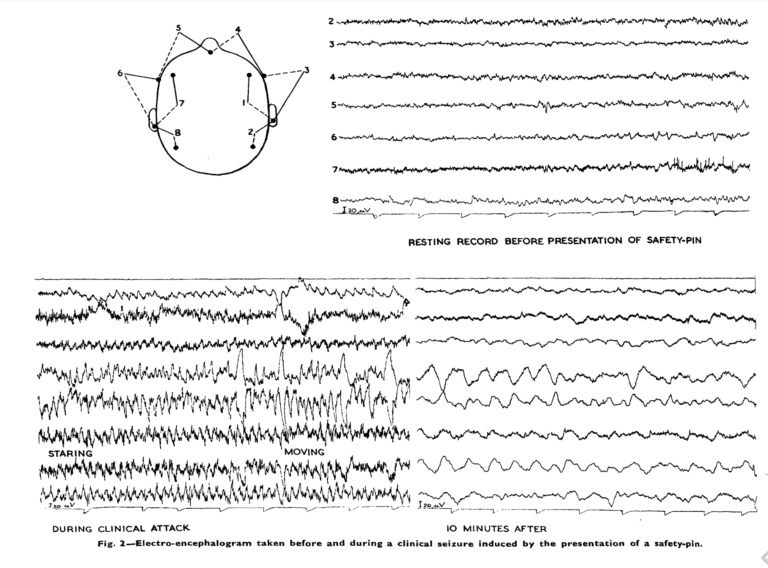
In any case, the epileptic fits (if not the fetish itself) had evidently caused the man sufficient distress that he sought treatment. (He’d also experienced a few episodes of psychosis, presumably epilepsy-related, in which he believed himself to be a relative of the king or a messenger of God.) After confirming epileptic activity with brain tests in the lab, both before and after showing him safety pins, doctors surgically removed the part of his anterior temporal lobe that the tests had determined were the problem area.

16 months after surgery, the man came back into the hospital for a follow-up. Amazingly, he reported he had had no further epileptic fits and no further desire to look at safety pins. His boner issues had even resolved; he was now able to have a full and satisfying sex life with his (frigid??) wife. Further brain tests were done and confirmed that, unlike before the surgery, nothing major changed in his brain activity when he looked at a safety pin. The fetish was effectively gone.

Reading this study left me with the question: Is it good – morally, practically, or otherwise – to take away someone’s fetish if it’s causing them consternation? Obviously there are cases where reducing or removing a particular aberrant desire is arguably necessary for the greater good, like when pedophiles with a history of committing sexual assault are chemically castrated; I’m not totally sure how I feel about these measures, but many healthcare professionals and even some pedophiles themselves think this is the best option. In cases where a fetish isn’t causing harm, however – or is only causing harm insofar as it’s stigmatized and creates friction in the fetishist’s relationships and/or self-image – can we really say it’s “good” to take away the locus of someone’s passionate desire?

Like the kinky equivalent of conversion therapy, many methods have been suggested for “removing” people’s kinks from their brains. But also like conversion therapy, it seems to me that this line of thinking only comes up because we live in a world that so deeply stigmatizes some people’s perfectly acceptable desires. Who is harmed by this man having a safety pin fetish? Maybe his wife, who wanted a better and more conventional sexual connection with her husband – but perhaps then she should’ve picked a different partner, or learned how to use his fetish to arouse him during sex. Maybe he himself is harmed, in that he felt inadequate and weird because of his fetish – but arguably that’s just a function of cultural kinkphobia. Both of these people were probably just trying their best, within a time period that severely limited the ways one could think about fetishism – but this attitude often still persists today, at a time when we’re much better-equipped to handle and think about fetishes, and it’s sad.

While I’m glad that the man in this study was seemingly cured of his epileptic episodes, I wish he had been able to hang onto his fetish – without it upsetting him or troubling his relationship. Looking at safety pins, after all, was “the greatest experience of his life,” even if he no longer cared to do it after his surgery. It saddens me to think that anyone could see that type of exquisite “thought satisfaction” as anything less than healthy, wonderful joy.