My New Work-From-Home Setup, Part 1: Working in Bed

Lately I’ve been overhauling my entire work setup at home, and loving it. Seeing as I’m now fully self-employed and perpetually juggling a full docket of blog posts, client work, podcasting, and book-writing, it felt important to make some changes so my setup would be as well-tailored to my needs as possible.

I’m gonna do another blog post soon detailing the changes I made to my main workspace at my desk (I’m just waiting on my new monitor to be delivered!), but today I thought I’d tell you about another “workspace” of mine that I’ve also overhauled recently. Let’s talk about what I use when I’m working from my bed.

See, as a chronically ill person, there’s usually at least 1-2 days per week when I’m too achy, sleepy, and/or gloomy to sit at my desk for long stretches of time. On those days, I tend to curl up under my duvet, surrounded by strategically-placed pillows, for a supine work sesh.

My old bed-work setup consisted solely of my laptop (a MacBook Air) and a lap-desk from IKEA that keeps my computer from overheating on the duvet and also has a compartment where I can store my iPhone upright for easy access. However, my 13” computer is a bit bulky for this purpose, and I wanted a system that was smaller, sleeker, and more portable, especially since (in non-pandemic times) I travel a fair bit and don’t always want to bring my big ol’ lap-desk with me.

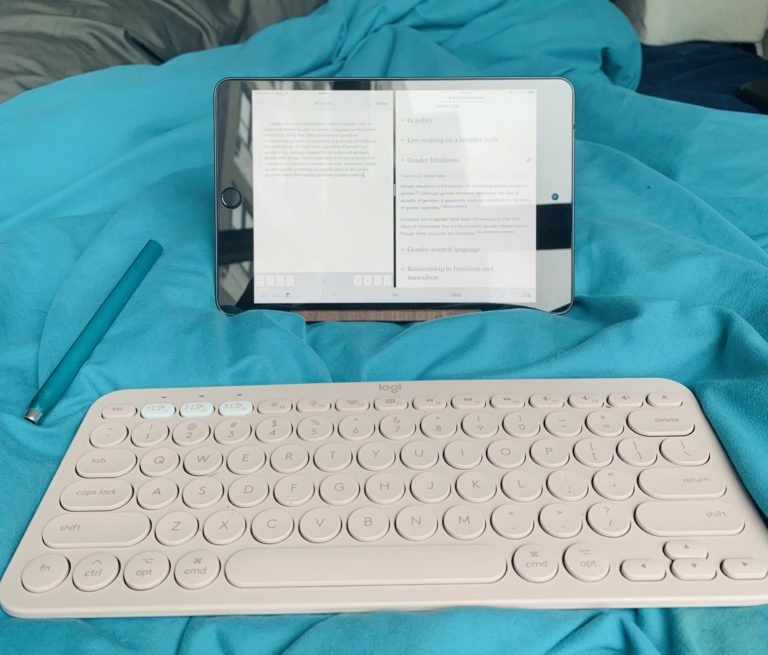
The main component of my new bed-work setup is an iPad mini 5. Mine is a 64GB model in space grey which I bought refurbished last year, having noticed that my chronic pain had gotten bad enough to warrant a smaller, lighter device for difficult days. In the months since, I’ve more often used it as a leisure device, for watching Netflix, YouTube, and (yes) porn – but it works quite well for professional tasks as well, because it’s fast, powerful, and versatile, and has a beautifully bright and vivid screen.

When I want to work on my iPad, I hook it up via Bluetooth to my pale pink Logitech K380 keyboard. I picked this keyboard because it’s one of the Wirecutter’s top recommendations, and I absolutely love it. The keys are pleasantly clicky-clacky, which I enjoy in contrast to my laptop’s hyper-quiet keys. I also love that this keyboard can be connected to up to 3 devices at a time, which you can switch between with a press of a button. This means I can use the same keyboard whether I’m typing on my computer, my iPad, or my phone. It’s quite slim and light, so it’ll be easy to throw it into a purse alongside my iPad if I ever want to get some work done at a café or another public place. The one thing this keyboard lacks, that I wish it had, is a slot for propping up my iPad so I don’t have to bring an iPad stand with me. I recently ordered a typewriter-inspired Knewkey mechanical keyboard which will do a better job of this when I need it.
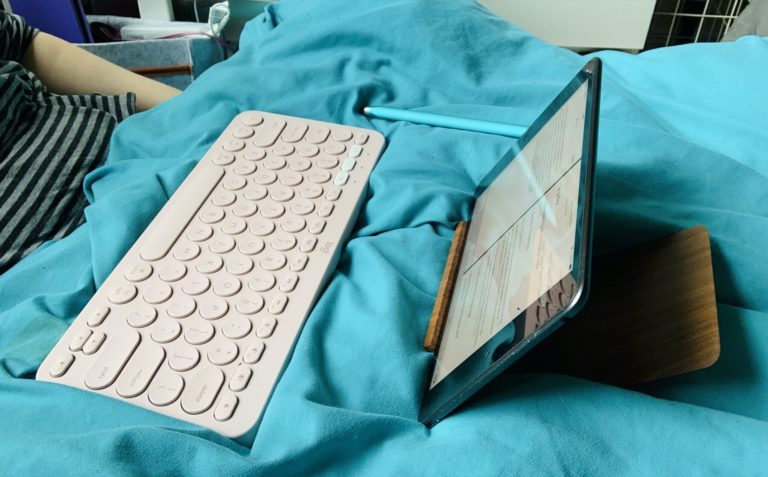
Speaking of iPad stands, I do need one while working in bed, and the one I chose was a recommendation from my tech-nerdy spouse mb. It’s the Yohann iPad mini stand, a gorgeous piece crafted from walnut. mb recommended this stand for me largely because it’s designed to work well on soft surfaces, like a bed; its curved design enables it to keep my iPad upright at a workable angle even as I shift around in bed, adjust my pillows, etc. At $129 USD, this was a pretty hefty investment for something that simply holds my iPad up, but it’s 1,000% better than what I was doing before (attempting to prop up my iPad against a stack of pillows or books), so to me it was worth the dough.

The final component of my work-from-bed setup is my Adonit Mark stylus, which I bought because the Wirecutter recommended it and also because it comes in a stunning shade of turquoise. (I love this shade so much that it’s actually the exact color of my duvet cover, which unfortunately means I sometimes misplace the stylus in my bed due to how well it blends in!) At just $20, this was the least expensive part of my bed-work overhaul. A stylus enables me to “click on” things on my iPad’s screen without having to reach too far with my hands, which is suuuper helpful on bad shoulder/neck pain days.

I also have a 6-foot-long charging cable for my iPad, so I can charge it while I’m working no matter where I choose to situate myself in my bed. I am a big fan of extra-long charging cables in general, especially for chronically ill people, because unlike shorter cables, they don’t require you to choose between charging your device and staying in a comfortable position.

Software-wise, on my iPad I usually use Google Chrome for any in-browser writing (such as this blog post), Google Docs for articles and client work, and Scrivener for my books. These all sync across my various devices seamlessly, making it easy to move my entire workflow from my desk to my bed when I need or want to.

This is what’s working for me; I’d love to hear from other writers in the comments about what works for you when you write in bed!


Building a Chronic Illness Wardrobe

Weirdly, one of the saddest parts of my slow descent into chronic pain hell is being unable to dress the way I used to. 💔

Even setting aside the issue of how my body shape/size has changed since becoming less mobile (because I ain’t about that fat-shaming life), there are some types of clothes I just can’t wear anymore, or at least not very often. My beloved rockabilly dresses have nipped waists that dig into me uncomfortably; luxury lingerie stabs me with its underwires and lace; even jeans often feel painfully restrictive. I was never much of a high heels person, but now even sturdy heeled boots sometimes hurt me. It suuuuucks.

However, slowly but surely, I’ve been re-learning how to dress myself in what feels like a completely different body than I had in my teens or early twenties. Here are some of my top picks; maybe they’ll help you if you also have chronic pain/illness, or even if you just like comfy clothes!


Leggings and lounge pants have become foundational to my style. I used to wear tights under dresses most days, but over the years I’ve slowly transitioned to wearing leggings under my dresses instead, because they’re comfier, more durable, easier to put on in a hurry, and can double as pants for sleeping in or lounging around the house. (Or wearing out, frankly. The “leggings are not pants” brigade can fuck right the hell off.)

These TrueSleep modal joggers by the Gap are some of my faves right now; I have a few different pairs. Modal is one of the comfiest materials for my particular body. It’s stretchy, non-scratchy, and feels light as air against my skin. These pants have pockets – always a plus – and they have a slim enough cut that they can pass for leggings if I throw a dress over them before leaving the house. They’re marginally see-through because the fabric is so thin, which is admittedly a drawback, but I barely wear them out of my apartment so it doesn’t really matter. I also love my Ureshii leisure pants, which were made-to-measure and are soooo comfy and soft.


Cute tops help me feel like a human even when my body isn’t cooperating. I’ve recently sought out soft lace-edged tank tops as a replacement for the oversized T-shirts I tend to rock with my lounge pants, because any little thing I can do to feel more femme is helpful when I’m achy and insecure.

Looking in the sleepwear section of any clothing store is always a good bet for pain-friendly clothes, because those garments tend to be specifically engineered for comfort and mobility. I always keep an eye out for “sleepwear” items that don’t look like pajamas; they are truly the holy grail.


Modal slips are a lifesaver for me. My first one was a black satin-edged Calvin Klein one that I bought a decade ago, and it’s held up so well and gotten me through so many pained days that I recently ordered a couple more: a short one in black and a longer one in a rosy red. These are way more glamorous than sweatpants but just as comfy (if not moreso), and can even be worn out of the house if layered appropriately with leggings and a cardigan or somesuch.

I’m curious about silk slips – they seem like a summertime equivalent of my modal ones, and are ultra-glam – but the one I want most isn’t available in my size, so I’ll keep looking, I guess! I also dream of someday ordering a bespoke Ureshii jersey dress; their cuts are gorgeously flattering but they’re made of super-soft fabric.


Bralettes are a must-have for times when I want some boob support but am in too much pain for a proper bra. Truth be told, I don’t wear bras or bralettes all that often, because I’ve basically stopped caring about my nipples being visible or whatever, but sometimes I want to feel a little fancy so I’ll put one on.

Some of the comfiest ones I’ve found are by Aerie. I usually avoid lace because I can’t handle the itchiness against my skin; soft fabrics are where it’s at. If I ever want to go the whole nine yards, I could order some made-to-measure jersey bralettes from Ureshii (drooool).


Cashmere sweaters are super comforting and cozy. They especially help me when cold weather is causing pain flare-ups; one day I’d love to own a pair of cashmere leggings for similar reasons (feel free to recommend some in the comments!). My favorites right now are by J. Crew but it’s pretty easy to find vintage cashmere for a steal on eBay, Etsy, Depop, etc.

Cashmere also layers really nicely with materials like modal and silk. The extreme softness of it makes me feel swaddled in safety. Truly ideal.


Ugg boots are a controversial pick, but whatever. They’re incredibly comfy, even when I’m having one of those weird pain days where just walking around hurts my feet and legs. I often even wear mine around the house.

The ones I have are adorned in sequins, but I’d eventually like to get a classic black pair because they’re subdued enough that they don’t scream “Paris Hilton in 2003.” (Not that there’s anything wrong with Paris Hilton… but she and I have different aesthetics!)


Jumpsuits and rompers are best for those days when I just can’t be bothered with separates. My favorites are by MeUndies, whose rompers are so sinfully soft that they’re even comfier than being naked (for my body, anyway). And they have pockets. Incredible.
The Gap makes a Softspun V-neck jumpsuit and a modal romper that both intrigue me. In summer I could wear these out of the house and probably no one would bat an eye. Cool!


Fellow folks with chronic illness/pain, what changes or additions have you made to your wardrobe to accommodate your condition?

On Being a Chronically Ill Writer

My daily routine is more affected by my chronic illness than I’d like to admit. Work can’t start until I manage to forge a path through my fatigue with the requisite amount of coffee and good music; task-switching and location-switching are informed by which positions my body can tolerate that day and which it refuses to; and when my pain decides that the work day has ended, I usually have to listen.

It’s – to say the least – a bummer, especially since I used to be renowned among my friend group and my online communities for my productivity as a writer. The same impulses still come up as before, the ones that pushed me toward creativity and stamina and long sore-eyed hours in front of the computer, but my body cannot enact my mind’s wishes on most days now and it makes me feel like a failure. Like I’m failing not only myself but also all the people who taught me how to write and all the people who believe (or believed) in me as a writer.

I seem to come back to Esmé Wang’s blog The Unexpected Shape over and over again as I wade deeper into the chronic illness life. Esmé is one of my favorite writers, and – like me – she deals with pain and fatigue (among numerous other symptoms) as part of her daily life. She’s written a lot about “creating a healthy writing practice when your health doesn’t want to cooperate,” and I’ve found her suggestions helpful, so here are some of mine, incase they can help anybody else.

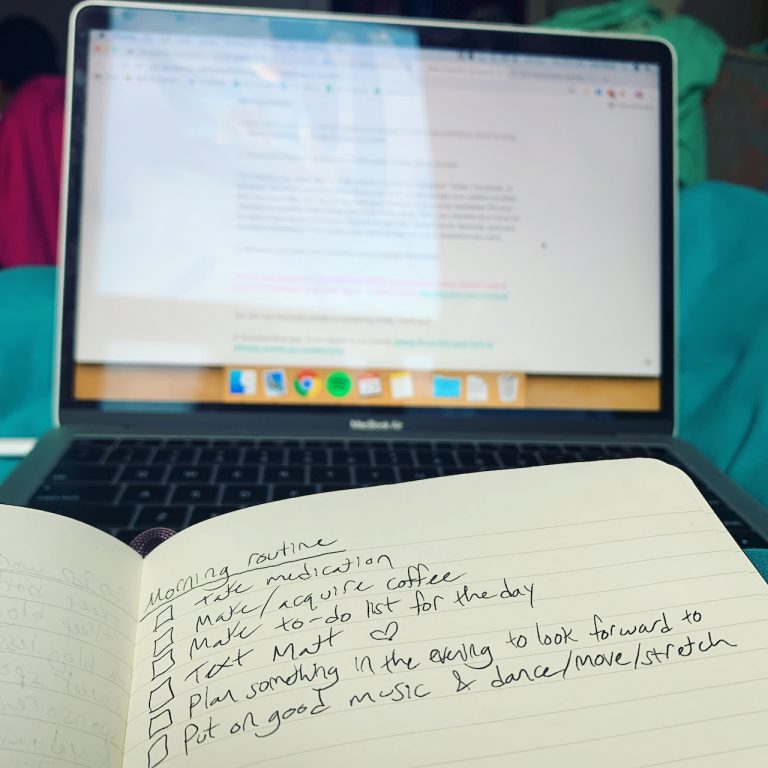
I keep a to-do list almost every day, which boils down my most pressing tasks to an easily digestible form. The desire to tick those boxes and complete the list is sometimes stronger than the downward gravitational pull of my body’s limitations. When there’s only one more thing left to do on the list, usually that fact alone is enough to get me to roll up my sleeves and work on it – even if, by that point, I have to go very slowly and take many breaks.

I have a padded lap desk that I use when I’m in bed, to hold my laptop steady and keep it from overheating on the duvet, or burning my skin (temperature sensitivity is sometimes a symptom of mine). However, depending on where my pain is manifesting on any particular day, it may not always be possible to comfortably work in bed – so I move around, from the bed to the couch to the desk to the chair, looking for a few minutes of relief in which I can type a few hundred words or answer a few emails.

On days when my body is rebelling so much that even sitting at my computer feels exhausting and unfeasible, I’ll use the Notes app on my phone, which syncs to my other devices so I can easily copy and paste the text to where it needs to go later when I’m able to. I haven’t needed dictation software as of yet – the way I write and edit is exacting and particular in such a way that I get frustrated at the very thought of not being able to see what I’m writing as I write it – but am keeping it in mind for if/when my level of debilitation progresses enough to make it necessary. On especially bad days, sometimes I’ll write in longhand (I like Blackwing pencils and Moleskine notebooks; they make this process feel glamorous and easy) and then type up the words when I can.

I rely a lot on pre-scheduling. This was always true, due to the way the hypomanic episodes of my early 20s made me want to write, write, write on certain days while depression kept me uselessly crying in bed on other days. Now, I’m more aware than ever that any day – or even hour – when I feel capable of working is worth taking advantage of, if I can. Doesn’t matter if a blog post won’t be published until Thursday; one motivated and limber-fingered hour on Tuesday might be the right time to get it done. I try, as much as I can, not to leave writing tasks until the last minute before the deadline, because I can’t control what my body will be doing at that time.

I take naps as needed, which I’m fortunate to usually be able to do, due to my freelancer lifestyle. A good eye mask is a must-have for mid-day naps. My body pillow helps keep me comfortable while I’m resting. I use the Clock app on my phone to set timers/alarms so I don’t nap the whole day away.

I have a cheap microwaveable heating pad with Velcro straps that can be positioned on sore body parts as needed. I want to amass a collection of these so I don’t have to choose between treating multiple sore body parts on especially bad pain days.

Comfortable clothing is crucial, especially since my fibromyalgia-esque chronic illness sometimes causes flare-ups of hypersensitivity to scratchy or restrictive garments. I like extra-soft tri-blend T-shirts, MeUndies modal underwear and lounge pants, and (when I’m feeling a bit fancier) modal slip dresses and vintage silk robes. I particularly like loungewear that can be re-styled in an outdoors-appropriate way incase I need to dash out for a coffee or some groceries.

I’ve started using a pain tracking app to keep records of my pain’s intensity, locations, triggers, and treatments. I like this one because it’s super customizable; I can, for example, add “orgasms” as an option in the treatments category, or track my anxiety levels alongside my pain levels to see if they match up, or input impending menstruation as a potential trigger.

I’ll sometimes take a mid-day bath when my pain is especially bad, because I find the hot water gives me some relief for a while. Epsom salts are supposedly good for pain relief because of their magnesium content. Some people write in the bath; I haven’t yet figured out a way to do this that feels safe and sustainable for me, since I don’t want to get electronics close to the water and I worry about dropping my notebook into the tub. Maybe one of those wooden bathtub trays is in my future. For now, if I need to continue working while in the bath, I usually use it as reading/research time – my Kindle Oasis is waterproof and I can load it up with PDFs of my choosing, like scientific studies I intend to cite in an article or books I’m assigned to review.

Finally, one of my greatest tools in the fight against pain is cannabis – which, fortunately, is legal where I live. (By the way, why the fuck hasn’t Canada pardoned and freed everyone who is incarcerated on cannabis-related grounds? It’s bullshit with hugely racist motivations and manifestations. Anyway…) Usually weed makes me too spacey/giggly to work properly, so I mostly leave it until the end of the day when all my work is done, but sometimes my pain is bad enough that I need to treat it in order to focus on any task. In that case I’ll try to pick a strain high in CBD and low in THC, use it sparingly, and schedule my day so that I’m doing highly methodical or highly creative tasks while high – never anything requiring a lot of logical analysis or careful phrasing.

That’s what’s working for me right now. I’d love to hear from other chronically ill writers in the comments (or in your own blog posts, if you prefer – send me a link please!) about how they manage their symptoms and get their work done.


Additional resources I’ve found helpful on this topic:

Got Chronic Pain But Love Giving Handjobs?

I remember the first time I realized my chronic pain disorder might seriously mess up my sex life. I was kneeling in front of a dominant gentleman friend, sucking his cock while he tugged at my hair, when a telltale twinge of pain began to creep up in my knees. They were, at that time, my most painful and volatile body part – and blowjobs were, at that time, my most beloved and calming sex act. I shifted around, tried putting a pillow under me, tried sitting on my ass instead, but it was a lost cause. My knees had cockblocked us both. Defeated, I finished out the encounter with a handjob.

Handjobs have long been one of my favorite things to do to a partner, so this wasn’t exactly a consolation prize, at least for me. But in recent years, pain in my hands has plagued me even more than pain in my knees. It’s a bummer to realize that the sex act I once turned to when I was in too much pain to do anything else is now sometimes off-limits to me due to pain.

Fortunately, I’ve always had partners who were very understanding about this issue. They’ve typically been fine with me cuddling up to them and kissing their neck while they jerk themselves off, or playing with their nipples while they fuck a Fleshlight. But as any handjob-giving aficionado will tell you, sometimes the joy in acts like these isn’t just about observing your partner’s pleasure, but in directly causing and controlling it. And in that regard, there was only so much I could do.

So when a company called Handy emailed me about their new product, I was intrigued. Designed by a Norwegian engineer, the Handy is an electrically-powered mechanical stroking device, much like the unfortunately-named Sybian Venus for Men – but it only costs $169, while the Venus costs a whopping $956. Okay, Handy; I’m listening.

To be fair, the two products aren’t really as comparable as I initially thought: the Venus is custom-constructed to fit your exact dick measurements, and uses different mechanics to create a sensation I have to assume is pretty different from the Handy’s. But if using a Venus is on your bucket list despite clearly not being in the cards for you financially, maybe the Handy would be a good substitute.

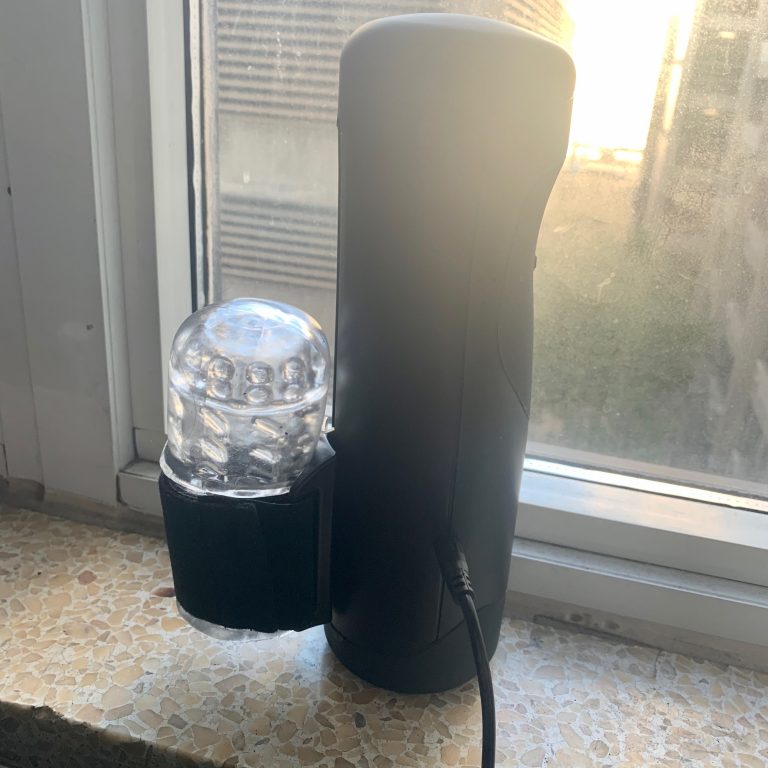
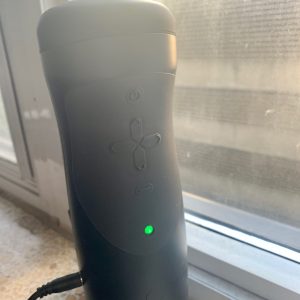
So what is this toy? It’s a somewhat clunky, Fleshlight-shaped mechanical cylinder attached to a fabric band which you can wrap around an included masturbation sleeve (of unknown material, though probably some kind of thermoplastic rubber/elastomer, and definitely porous – ergo, don’t share it with anyone you’re not fluid-bonded with). The band moves the sleeve up and down over the penis once it’s inserted, and you can use the 4 buttons on the Handy to control the speed of each stroke as well as the length of the stroke.

Setup is slightly annoying, as you have to keep adjusting the tightness of the band with its Velcro strap depending on how hard your dick is and how much pressure it’s craving at any given moment. But if you’re already pretty hard and aroused by the time you start using it, that might be less of an issue. Lube is also an ongoing consideration, as with just about any penile masturbation toy; the company recommends water-based only, and you may need to reapply during use, especially if your session runs long.

What I love about this toy, as a “handjob top,” is how much control it gives me. When I use my hands on a partner’s cock, I’m not just altering the speed, I’m also altering the length and location of my strokes – so I’m glad to have a toy that can approximate that, however clunkily compared to the nuance of skilled hands. The “left and right” buttons on the control unit are for speed, and the “up and down” buttons control the stroke length; everything is close together, so I barely have to move my hand or expend any muscle energy when I’m using this toy.
One small complaint is that it’s difficult to know exactly what to do during a partner’s orgasm. When using my hand, normally I would either hold still while maintaining pressure, or slow down and lengthen my stroke quite a bit for the duration of the orgasm; when post-orgasmic hypersensitivity hits, it’s easy to remove your hand quickly, but it’s trickier to do that with the Handy. You can hit a bunch of buttons to swiftly slow the toy down, but removing it from the dick in a rush is likelier to cause more discomfort than just leaving it in place would. However, this’ll only be a minor issue for most people, and some might even like it if they enjoy an overload of sensation.

Cleaning is also an annoyance, but that’s true for pretty much every stroker/masturbator. Resist the temptation to fall asleep in a post-orgasmic haze, and make sure to rinse the cum and lube out of the stroker within a few minutes after using it, or you’re in for a gunky, moldy surprise later on.

If this were a standard review, I would touch on the video synchronization and smartphone-control features of the Handy, and I’m sure that they would help folks whose hand pain is even more severe than mine. But for my purposes, I prefer to get as close to hands-on as I comfortably can, so physically holding the toy works better for me.

Overall, if you have pain/mobility/strength issues in your hands and would still love to be able to give handjobs (or jerk yourself off), I think the Handy is a worthy investment. The band-and-sleeve system makes it so that you could theoretically swap out the provided stroker for a different one, if there’s another texture or size you prefer. You can therefore get more variety of sensation out of this toy than many other comparable ones, especially considering the flexibility of the controls scheme. $169 is a bit steep for some people’s budgets, sure, but I’ve never seen a toy of this type and caliber sold for any less – so when fellow sore-handed people ask me how they can keep on strokin’ dicks, now I know to recommend the Handy.


Full disclosure: Handy didn’t pay me for this review, but they did send me the product to try (thanks!) and I do get a small kickback if you buy through my affiliate link. Want more sex toy recommendations for folks with chronic pain? I wrote this article recently for Xtra on that very subject!

15 Sex Toys For When Your Hands Hurt

My hands hurt most days lately. It’s one of the many manifestations of my as-yet-undiagnosed chronic pain disorder, and a particularly annoying one, given that I type words for a living. Fun!

However, in better news, I have noticed that the sex toy industry is (slowly, slightly) starting to become more inclusive of folks with chronic pain and other disabilities. Here are some toys I think could be useful if you, like me, struggle with pain, inflexibility, and/or weakness in your hands…

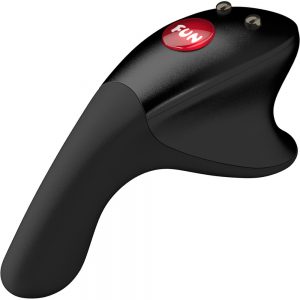
The Fun Factory BeOne is a bullet-sized vibrator that fits comfortably between two fingers, so you don’t have to grip it with your sore hands. The tip curves comfortably into the clitoris without much effort or angling required. I wish the motor was rumblier, and that the button for changing speeds was placed more conveniently (I can’t hit it without temporarily changing my finger placement, which disrupts flow sometimes), but I’m glad vibes like this exist. Along similar lines, you could also try “finger vibes” like the Jopen Key.

I recently got my hands on a Tenga SVR, a small vibrator attached to a silicone loop. You can use this contraption as a cock ring that offers external stimulation for the clitoris or perineum during penetrative sex, or you can use the vibrator clitorally while the loop is wrapped around two or three of your fingers. This gives a little extra grip and stability, which I find useful when hand pain is flaring up. This vibe is also great for finger-banging, an idea I first found out about from Kevin Patterson: you can slip your fingers through the loop and then slide them inside your partner, and the vibrator portion of the toy will stimulate them externally. Neat! (The LoveLife Rev looks to be a similar type of vibe, though I can’t attest to how it holds up against the SVR’s motor, which is wonderfully rumbly and strong.)

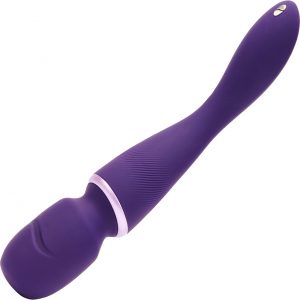
The new We-Vibe Wand has a feature called SmartSilence that a lot of reviewers have hated, but that could be useful for folks with pain or strength issues in their hands. The feature causes the toy’s vibrations to “pause” when you remove the toy from your body, and resume once you bring it back into contact with your skin. While I can understand why some people find this aggravating, it might be useful for those moments when you need to re-lube a dildo, adjust the vibration speed, take a drink of water, answer a text, etc. but don’t want to expend precious hand function on pressing finicky buttons. Just lift the vibe away from your body and go do what you gotta do.

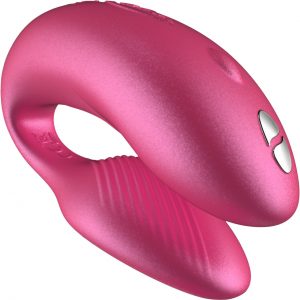
While I’m talking about We-Vibe… Hands-free vibrators like the We-Vibe Sync (read my full review here) are a godsend on bad pain days. I like this one in particular because you can adjust the two hinges so that the toy applies your ideal amount of pressure to both your clit and your G-spot. You can control the Bluetooth-enabled toy with an app on your phone, which I definitely find less physically taxing than pressing buttons.

Another new, potentially helpful product from this savvy company is the We-Vibe Chorus. It’s very similar to the Sync in shape and motor quality, but it uses a technology called AnkorLink that’s supposed to be more reliable than Bluetooth (so less tinkering required), and its accompanying remote optionally lets you control the vibrations by squeezing it: harder squeezes = stronger vibrations. Depending on how your hand pain manifests, this might be easier for you than pushing buttons or operating an app.
Pulsators, in general, are a lovely option for chronic-pain sufferers, because (as long as you brace yours against something like a pillow between your legs) you can get “fucked” without the exertion of manual thrusting. My current favorite is the Fun Factory Stronic G (read my review here), though if you’d like some rumbly clitoral or perineal vibration alongside your pulsation, the Bi Stronic Fusion is also terrific.

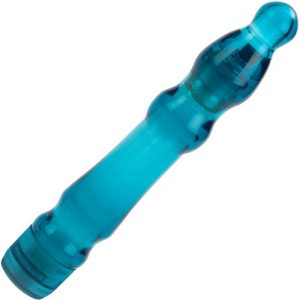
On bad pain days, I prefer vibrators with dials over those with buttons, as I find them easier to operate. The CalExotics Turbo Glider (read my review here) is a classic, and – while it lacks the bells and whistles of many other vibes I’ve mentioned here – it holds up, despite how long it’s been around. And it costs less than $20! If you don’t mind spending more to get more power, many BodyWand models also have dials instead of buttons.

If you have a prostate and like to have it stimulated, some of the best hands-free options for that are Aneros prostate massagers. They’re designed to rock back and forth against your spot when you squeeze and relax your muscles. Some people can even have orgasms from this alone!

As for penile stimulation, some kind of vibrator is probably your best bet if your hands hurt – it won’t require as much (or any) squeezing and stroking; you can just hold it on your shaft and/or against your frenulum and it’ll do the work for you. These toys even work without an erection in many cases. Two of the most popular and high-quality options on the market right now are the Fun Factory Cobra Libre II and the Hot Octopuss Pulse Solo Lux. (The latter can even be controlled with a wristwatch-like remote, for added ease of use.)

Finally, I would be remiss not to mention the Liberator Jaz, a compact sexual positioning aid made of firm foam covered in soft, washable microsuede. (Read my full review here.) Sometimes my hand and arm pain is so bad that it hurts even to reach all the way down to my genitals unaided; the Jaz tilts my hips toward me, not a lot, but enough that it’s not so much of a strain to touch my own junk. I’ve had mine for years and I still adore it.

What sex toys do you turn to when your hands are achy?