How to Write 1,000 Blog Posts

I literally cannot believe this, but… this is the 1,000th blog post to be published on girlyjuice dot net. WOW.

This somehow feels like a more momentous milestone to me than more time-based ones, because just saying “I’ve been blogging for eight and a half years” doesn’t give you a whole lot of info about what that has actually entailed. But it’s a whole different ballgame when I say it this way: I’ve been blogging here for 3,114 days, and have written 1,000 blog posts in that time, which averages out to 2.25 blog posts per week EVERY WEEK for nearly a decade. Yeesh. I’m so proud of myself that I’m not even trying to rein in the congratulatory self-indulgence in this paragraph!

With that in mind, I know a lot of bloggers and other types of writers follow me here, so I thought I’d share some of what I’ve learned about creating massive amounts of blog content over multiple years. It hasn’t always been easy, but I’ve always found my way back to it whenever I strayed or slacked for a while. Here are some tips that I hope help you if your goal is to make it to 1,000 blog posts or beyond!


Pick a subject you’re enthralled by. Maybe don’t start a blog about, like, 18th-century Viennese architecture, unless you’re actually so captivated by it that you think you have several dozen blog posts’ worth of thoughts to share on the topic. The vast majority of blogs burn out – and while there’s nothing necessarily wrong with that (I know not everyone is aiming to make their blog their job, as I have), if you’re in it for the long haul then it’s best to set yourself up for success. I chose to center this blog around sexuality because I could think of literally zero other subjects that I genuinely felt I could keep writing about forever, and it turns out I was right: the landscape of human sexuality is always changing, and so is my own sexuality specifically, making it a rich vein of blog post ideas.

…but also, don’t limit yourself to one subject. If this blog was only a sex blog, I don’t think it would be boring, exactly – there are infinite subtopics within the field of sexuality – but it certainly would be less fun for me at times. I’m only human; I’m not always horny. Sometimes I’m too depressed or ill or heartbroken to contemplate sex, and that’s typically when I dive into writing about relationships, fashion, feminism, or mental health. Thanks very much to the ladies of the Blogcademy for introducing me to the idea that your blog can be like a magazine: geared toward a particular type of reader, and the topics (yes, plural) that they’d be interested in.

Develop a storage system for ideas. Frustrating but true: far too often, when you have a fantastic idea for a blog post but are too busy to jot it down, you’ll end up totally forgetting about it. Either it’ll languish forever in the back of your mind – “I really should write that one of these days!” – or you will actually forget you even had the idea in the first place. It’s crucial that you develop a way to collect all your random blog post ideas somewhere so you can use ’em later. I try to always jot down not only the title/main idea of the post, but also a few notes about its contents; for example, for this post, I wrote down “how to write 1,000 blog posts” followed by a few bullet points about the kinds of tips I was hoping to give. This helped jog my memory later when I sat down to actually write this post.

Develop regular features. I do a “Monthly Faves” at the end of each month, “12 Days of Girly Juice” at the end of each year, and have experimented with various other recurring features in the past. These are especially helpful when you’re going through a period of being extra stressed/busy/sapped of all creativity (hello, 2020!) because they give you structure and some kind of prompt. You don’t have to come up with 1,000 completely unique and different ideas to write 1,000 blog posts (although kudos if you can)!

Read social media, forums, and the news. Not all the news, certainly (god, I think my brain would explode from sadness oversaturation), but at least enough to know what’s going on in your field at any given time. You never know when a random news story might thrill/incense/sadden/alarm you into writing something brilliant. Keeping an eye on social media and relevant forums also helps you keep your finger on the pulse of what people actually do/feel/think, not just what mainstream news says people are doing/feeling/thinking – so you can answer questions a lot of people are wondering about, provide guidance on issues that confuse most folks, or unpack your own feelings on the hot-button issue of the day.

Talk to friends, family, partners – and people you disagree with. Conversations have been some of my best catalysts for good blog posts over the years. Sometimes all it takes is a simple statement like “I’ve been thinking about writing a piece on [insert vague topic here]…” and before you know it, you’ll be in a profound dialogue or heated debate with someone about the issue at hand. Often, conversations with smart people – whether or not they know much of anything about my chosen topic – can help me figure out a unique angle, an offbeat consideration, or a hot take. It’s most useful to converse not only with people you like, but also people who rub you the wrong way, because they may offer you a perspective you’d never considered before, or present a perfect ideological springboard for your argument. (Just don’t get sucked into debating alt-right trolls as if their arguments have any merit… Been there, done that; it’s never worth it.)

Pay attention to readers’ search terms. Certain services, like Google Analytics, allow you to see what search-engine queries lead people to your website. These are always illuminating; they tell you not only what you’re already helping people with, but also what you could be helping people with. Obviously, not all blog content needs to be helpful to the reader in order to be valid and good, but informational and “how-to” articles are often the most “shareable,” so it makes sense to focus on them at least some of the time. If you notice that a lot of your readers seem to be fruitlessly searching for answers to the same questions, maybe that’s a cue that you should answer those questions for them in a blog post.

Take the money (if you want to). It’s simply a fact of life in a capitalist society that you will be more able to devote time and energy to an activity if that activity pays. Not everyone gets to a point with their blog where it starts attracting hopeful advertisers – and sometimes that’s due to entire industries or genres of writing being chronically undervalued, which sucks – but if you do start getting that type of offer in your inbox, at least consider it. Some people are very hesitant to “sell out,” especially within a vocation that they adore, because they think money will drain the joy out of the whole endeavor – which indeed can and sometimes does happen. But for me, getting paid to blog has almost always just been a motivator. The more income I’ve earned through this site, the more I’ve been able to set aside other jobs and projects to focus on what I’m doing here – and (for me at least) that results in better, deeper, more interesting work.

Allow yourself to grow and change. While it can be tempting to stick with a successful formula once you’ve found one, your best writing will happen when you step outside the box you’ve inevitably created for yourself. Any reader who’s actually invested in you as a person will happily follow you into new territory (so long as you haven’t, like, taken the red pill or joined a pyramid scheme), and to the extent that you lose old readers when you switch things up, you’ll also gain new ones who are more in line with your present-day vision. I certainly would not have been able to write 1,000 blog posts solely from the limited perspective of the 19-year-old sex nerd I was when I started this blog – but writing 1,000 blog posts from my ever-shifting perspectives from ages 19 to 28? That was no problem at all.


What strategies have you found helpful in long-term blogging?
What’s Your Sunday Routine?

Sundays are the most anxiety-provoking day of the week for many people. For those of us with a standard Monday-to-Friday work week (which is, itself, a privilege in many ways), pre-emptive Monday nerves can sneak into Sunday and turn it from a relaxed respite into pins-and-needles panic. It doesn’t have to be this way!
Recently I read, with fascination, Rachel Syme’s Twitter thread about her favorite way to spend a Sunday. She calls it “Sunday Expert” and it’s a game in which you choose a subject you’re organically intrigued by and decide to make a day of becoming an expert on that thing. This can involve doing research in the form of article-reading and video-watching, or you can take a more feet-on-the-ground approach and physically go to a location that would help you in your research – you might, for example, scope out a house near you where a historical legend used to live, or (in pre- and post-COVID times) even visit a library to satiate your nerdy cravings. To me this seems like such a great way to infuse some fun and frivolity into a day that can otherwise feel so high-pressure and scary.

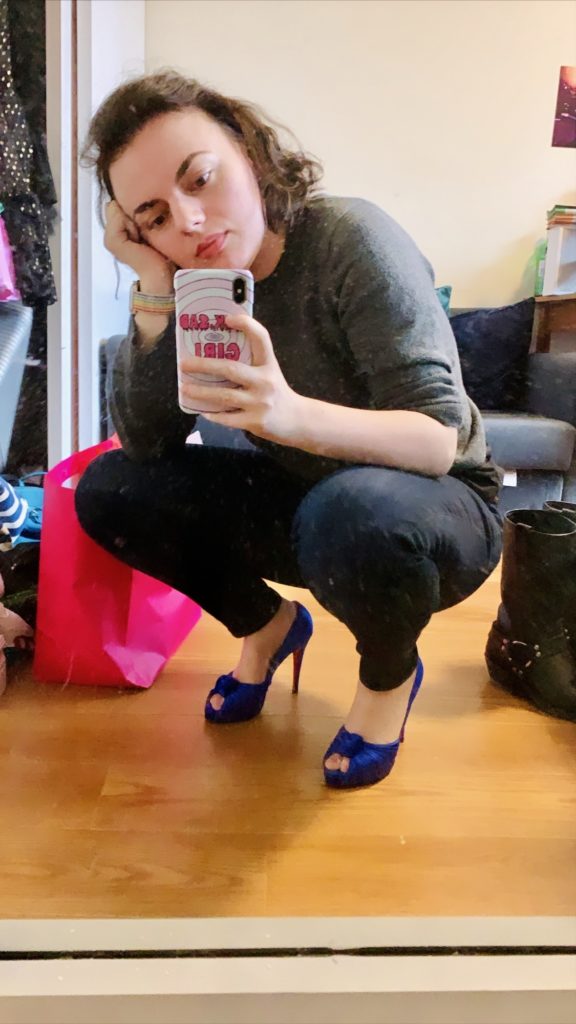
Rachel Syme also, incidentally, started the #DistanceButMakeItFashion movement, which encourages participants to dress up on Sundays and post pictures on social media to combat lockdown loneliness and pandemic melancholy. There is something about wearing heels and lipstick on a Sunday that helps me feel like I spent my weekend well and am ready for the week to start up again.

I know a lot of advocates of the Getting Things Done (GTD) system like to do their “weekly review” on Sundays. It’s all about processing “loose ends” – like that cheque on your desk you’ve been meaning to deposit, or that note you made early in the week that says “call mom” – as well as reflecting on how you did over the past week and setting goals and intentions for the week to come. This is all very Productivity Nerd™ and I admire it a lot, although I have to admit that my own workflow and energy levels are too chaotic for me to decisively commit to such a system.

My blogger heroine Gala Darling, on the other end of the productivity/relaxation spectrum, has oft advocated for “Sunday Funday,” a weekly ritual of just… not working, all day. For those of you who leave your work at the office when you go home on Friday, this might be a bit confusing, but for freelancers and other self-employed folks (as well as many people whose workplaces just don’t have a good handle on boundaries), it’s all too easy to let your work week carry over into the weekend. This creates a shitty cycle where you don’t get the rest you need and then suddenly it’s Monday morning and you’re just as exhausted as you were last Thursday. Not ideal! I’ve been trying to take this one to heart over the past few months, typically eschewing emails and other less-than-exciting work tasks in favor of rest and recuperation, and it’s lovely.

I asked my Twitter followers about their Sunday routines (thanks, if you contributed!) and the answers varied greatly, though there were some recurring themes: cleaning, planning, laundry, aesthetic top-ups (like re-painting nails or doing an elaborate skincare routine), exercise, and meditation. This all sounds pretty excellent to me!

As for my current routine… Recently my partner and I overhauled our protocol agreements, and one of the things we added was a weekly to-do list for me to complete over the weekend. This list of tasks was always done unofficially before – which is to say, sometimes it didn’t get done at all – but now it’s codified into a digital note which syncs to my partner’s devices so they can keep an eye on my progress. The list is pretty simple: tidy my room, clean out the fridge, take the trash out, do all the dishes, and wash all the dirty sex toys that have piled up over the course of the week. I can do these any time throughout the weekend, but I usually leave ’em til Sunday so I get at least one full day beforehand to do nothing, guilt-free.

What I like about this list is that I can alter the way I complete it in accordance with my energy levels and health status on any given Sunday. On healthy, happy, energetic days, I can knock out the whole list in an hour. When I’m feeling more sluggish or depressed, I might complete one task, rest for a while, do another one, read a chapter of a book, do another one, play video games for a bit, and so on. I do feel motivated to complete the list ASAP, however, because then I get the feeling of accomplishment of having ticked off every item on a list and I don’t need to feel guilty when I take the rest of the day to just chill.

This all sounds very Jordan Peterson of me – “Keep your room tidy and your whole life will feel structured and satisfying!” – but, hey, even a bigoted conservative clock is right twice a day (I guess…). Starting the week with a clean apartment makes me feel so much more able to take on the challenges the week will serve up. It also means I don’t have to juggle multiple energy-draining tasks on work days, when I’m already generally pretty tapped out by the time I close my laptop at 5 p.m. (or 6, or 7, or… 10).

As part of my tidying, I usually come across items I’ll need for the week ahead – like a sex toy I’m on deadline to review, or a page of notes from a client call – and I’ll collect those in an orderly way on my desk so they’ll be accessible when I want ’em. This makes me feel so much more sane and less stressed out all week long.

This is what works for me right now – I’m sure it’ll continue shifting and evolving as I learn more and more about my own patterns and needs. What are your Sunday routines and rituals?

My New Tattoo is an Ode to Writing

One oft-repeated truism about tattoos is that once you get your first one, you’ll just want more and more. Obviously this isn’t true for everyone, but it has certainly been true for me. I got my first tattoo 5 years ago and have gotten about one per year since then.

When I got my first book deal last year and submitted the completed manuscript earlier this year, I pondered tattoos I could get to memorialize the experience. Several linguistically-inclined friends of mine have writing-themed tattoos – an ampersand, a typewriter, a pen nib – and I always oohed and aahed over them while knowing that they weren’t ideal images for my own scribe-centric ink. I don’t use typewriters (at least, not since a multimedia zine project in 2010), I don’t often pick up a fountain pen, and plain punctuation just doesn’t jive with my preferred tattoo style: colorful, quirky, and fun.

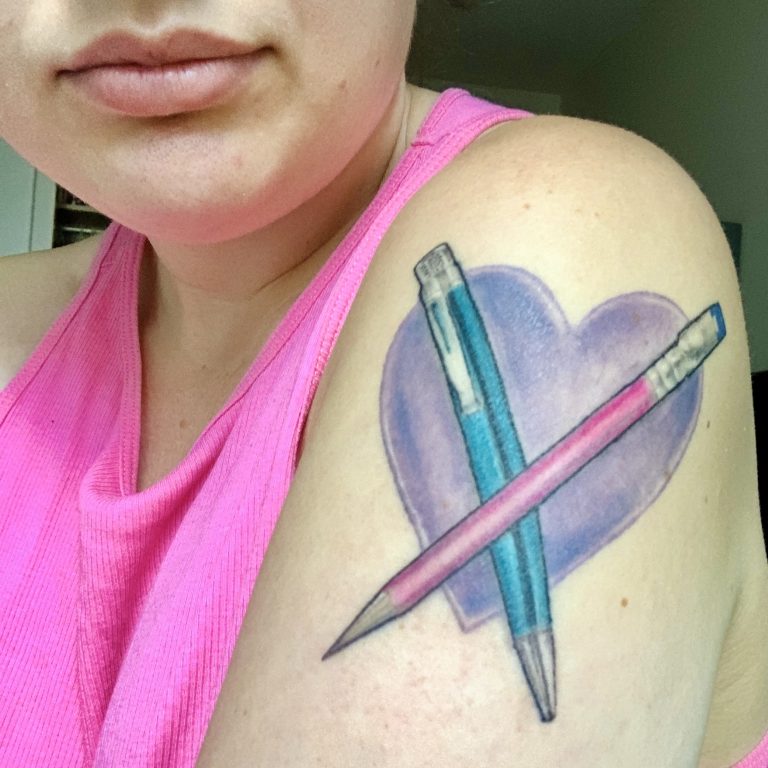
However, over the past couple years, two writing implements came into my possession that I thought were pretty enough to get tattooed on me: the pink and silver limited-edition Blackwing Volume 54 pencil, and the peacock-blue Retro 51 Tornado pen. Both have become desktop staples for me; I make scribbled notes with them during podcast recordings and journalism interviews, write in my journal with them over steaming cups of tea, tuck them into my bag when I go out incase of a writing emergency… These two tools have fast become some of the most beloved (and most beautiful) members of my collection.

I vaguely knew they might look good in a tattoo together on my upper left arm, perhaps with a purple background to bridge the color-spectrum gap between their pink and blue hues (and also to mirror the shades of the bisexual pride flag!), but I didn’t know exactly how they should be arranged on my skin. So I emailed Laura Blaney – the Etobicoke-based artist who also did the pink bows on my thighs and the stunning flowers on my right arm – and attached some reference images. We met up for a consultation at her studio, and I felt – as I have every other time I’ve gone to see her – that she 100% understood what I wanted, and would be able to provide it. Yay!

Unfortunately, then we had to postpone our appointment for 4 months because of the pandemic. But it wasn’t really that frustrating, because I got to spend those extra months thinking about the design and making sure I really, really wanted it – which I did. By the time we finally rebooked in July, Laura’s studio had put health and safety measures into place to keep the environment as COVID-proof as possible – and reputable tattoo parlors are also, by necessity, already pretty damn safe and sanitized to begin with.

On the day of my appointment, I took all my usual safety measures (mask, hand sanitizer, obsessive hand-washing), and took an Uber to the studio. The tattooing stations were appropriately socially distanced, and the few other people present were all wearing masks the entire time. Laura wiped down my phone and Kindle to sanitize them when I arrived, so I could use them safely while getting tattooed. We discussed layouts and colors a bit, settled on the design I wanted, and then started the inking process.
I had been worried it would be more painful than my previous tattoos, because my chronic pain disorder has gotten worse over the past couple years and some say it’s a result of increased neurological sensitivity to pain overall. But it barely hurt, and certainly not anywhere near as badly as my thigh tattoos, easily the most painful ones I’ve gotten (that skin is sensitive!). The only bothersome parts of it were the tops of the pen and pencil, where they curve slightly onto the bony part of my shoulder. Everything else was just a low-level scratchy feeling that I easily tuned out while losing myself in my e-reader.

The final result is exactly what I wanted: colorful, eye-catching, and meaningful. It’s a similar size and color palette to the floral tattoo on my other arm, so I look (and feel!) more symmetrical. And it’s also an instant conversation-starter about one of my favorite topics to discuss: writing!

Thanks so much, as always, to Laura for her tireless and meticulous work on this piece of art. I know I’ll adore it for many, many years to come.


Previous posts about my tattoos:

On Being a Chronically Ill Writer

My daily routine is more affected by my chronic illness than I’d like to admit. Work can’t start until I manage to forge a path through my fatigue with the requisite amount of coffee and good music; task-switching and location-switching are informed by which positions my body can tolerate that day and which it refuses to; and when my pain decides that the work day has ended, I usually have to listen.

It’s – to say the least – a bummer, especially since I used to be renowned among my friend group and my online communities for my productivity as a writer. The same impulses still come up as before, the ones that pushed me toward creativity and stamina and long sore-eyed hours in front of the computer, but my body cannot enact my mind’s wishes on most days now and it makes me feel like a failure. Like I’m failing not only myself but also all the people who taught me how to write and all the people who believe (or believed) in me as a writer.

I seem to come back to Esmé Wang’s blog The Unexpected Shape over and over again as I wade deeper into the chronic illness life. Esmé is one of my favorite writers, and – like me – she deals with pain and fatigue (among numerous other symptoms) as part of her daily life. She’s written a lot about “creating a healthy writing practice when your health doesn’t want to cooperate,” and I’ve found her suggestions helpful, so here are some of mine, incase they can help anybody else.

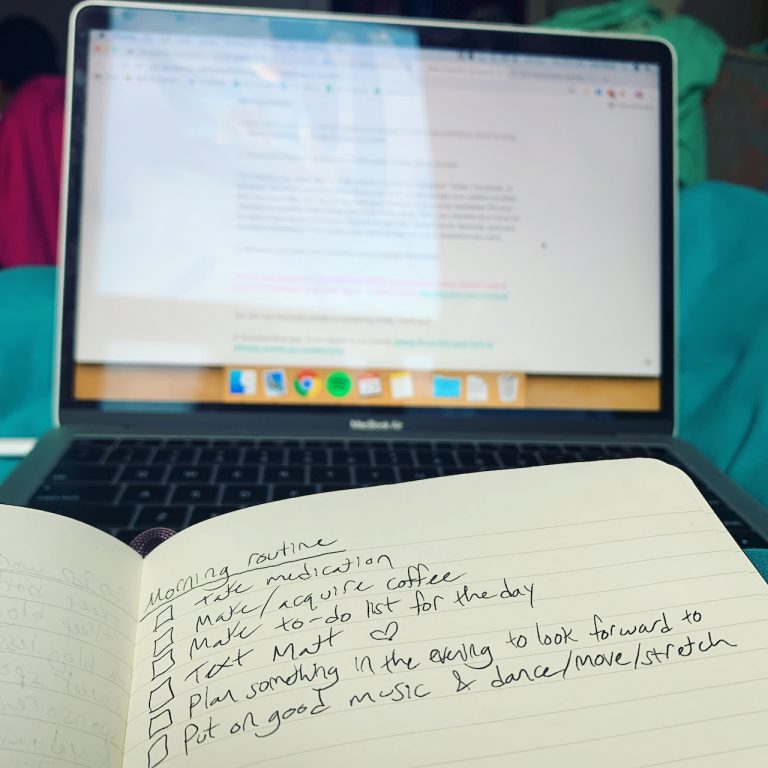
I keep a to-do list almost every day, which boils down my most pressing tasks to an easily digestible form. The desire to tick those boxes and complete the list is sometimes stronger than the downward gravitational pull of my body’s limitations. When there’s only one more thing left to do on the list, usually that fact alone is enough to get me to roll up my sleeves and work on it – even if, by that point, I have to go very slowly and take many breaks.

I have a padded lap desk that I use when I’m in bed, to hold my laptop steady and keep it from overheating on the duvet, or burning my skin (temperature sensitivity is sometimes a symptom of mine). However, depending on where my pain is manifesting on any particular day, it may not always be possible to comfortably work in bed – so I move around, from the bed to the couch to the desk to the chair, looking for a few minutes of relief in which I can type a few hundred words or answer a few emails.

On days when my body is rebelling so much that even sitting at my computer feels exhausting and unfeasible, I’ll use the Notes app on my phone, which syncs to my other devices so I can easily copy and paste the text to where it needs to go later when I’m able to. I haven’t needed dictation software as of yet – the way I write and edit is exacting and particular in such a way that I get frustrated at the very thought of not being able to see what I’m writing as I write it – but am keeping it in mind for if/when my level of debilitation progresses enough to make it necessary. On especially bad days, sometimes I’ll write in longhand (I like Blackwing pencils and Moleskine notebooks; they make this process feel glamorous and easy) and then type up the words when I can.

I rely a lot on pre-scheduling. This was always true, due to the way the hypomanic episodes of my early 20s made me want to write, write, write on certain days while depression kept me uselessly crying in bed on other days. Now, I’m more aware than ever that any day – or even hour – when I feel capable of working is worth taking advantage of, if I can. Doesn’t matter if a blog post won’t be published until Thursday; one motivated and limber-fingered hour on Tuesday might be the right time to get it done. I try, as much as I can, not to leave writing tasks until the last minute before the deadline, because I can’t control what my body will be doing at that time.

I take naps as needed, which I’m fortunate to usually be able to do, due to my freelancer lifestyle. A good eye mask is a must-have for mid-day naps. My body pillow helps keep me comfortable while I’m resting. I use the Clock app on my phone to set timers/alarms so I don’t nap the whole day away.

I have a cheap microwaveable heating pad with Velcro straps that can be positioned on sore body parts as needed. I want to amass a collection of these so I don’t have to choose between treating multiple sore body parts on especially bad pain days.

Comfortable clothing is crucial, especially since my fibromyalgia-esque chronic illness sometimes causes flare-ups of hypersensitivity to scratchy or restrictive garments. I like extra-soft tri-blend T-shirts, MeUndies modal underwear and lounge pants, and (when I’m feeling a bit fancier) modal slip dresses and vintage silk robes. I particularly like loungewear that can be re-styled in an outdoors-appropriate way incase I need to dash out for a coffee or some groceries.

I’ve started using a pain tracking app to keep records of my pain’s intensity, locations, triggers, and treatments. I like this one because it’s super customizable; I can, for example, add “orgasms” as an option in the treatments category, or track my anxiety levels alongside my pain levels to see if they match up, or input impending menstruation as a potential trigger.

I’ll sometimes take a mid-day bath when my pain is especially bad, because I find the hot water gives me some relief for a while. Epsom salts are supposedly good for pain relief because of their magnesium content. Some people write in the bath; I haven’t yet figured out a way to do this that feels safe and sustainable for me, since I don’t want to get electronics close to the water and I worry about dropping my notebook into the tub. Maybe one of those wooden bathtub trays is in my future. For now, if I need to continue working while in the bath, I usually use it as reading/research time – my Kindle Oasis is waterproof and I can load it up with PDFs of my choosing, like scientific studies I intend to cite in an article or books I’m assigned to review.

Finally, one of my greatest tools in the fight against pain is cannabis – which, fortunately, is legal where I live. (By the way, why the fuck hasn’t Canada pardoned and freed everyone who is incarcerated on cannabis-related grounds? It’s bullshit with hugely racist motivations and manifestations. Anyway…) Usually weed makes me too spacey/giggly to work properly, so I mostly leave it until the end of the day when all my work is done, but sometimes my pain is bad enough that I need to treat it in order to focus on any task. In that case I’ll try to pick a strain high in CBD and low in THC, use it sparingly, and schedule my day so that I’m doing highly methodical or highly creative tasks while high – never anything requiring a lot of logical analysis or careful phrasing.

That’s what’s working for me right now. I’d love to hear from other chronically ill writers in the comments (or in your own blog posts, if you prefer – send me a link please!) about how they manage their symptoms and get their work done.


Additional resources I’ve found helpful on this topic:

12 Days of Girly Juice 2019: 11 Favorite Blog Posts

By the end of this month, I will have written and published 133 blog posts in 2019. I am a fiend; somebody stop me!! (Except don’t; this blog has become my main source of income in recent years.)

To sum up the year – and to give you some reading material to hang onto for when you’re hiding from your family in the bathroom over the holidays (lol) – here are my 11 favorite blog posts I published this year! (Curious about previous years’ favorite posts? Here’s 2018 and 2017!) These are ordered chronologically, rather than preferentially. Let’s dive in!

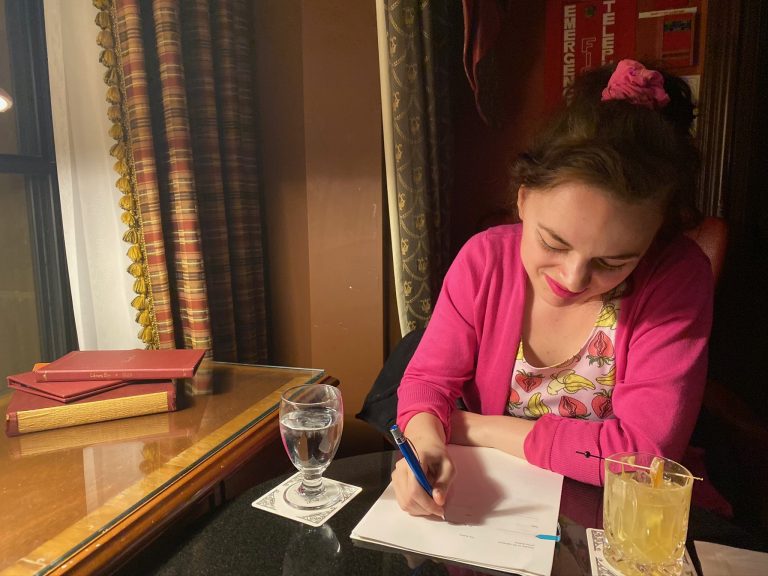
Early in the year, I wrote Roleplay and Rapport at the Library Bar,” a post chronicling a roleplay scene I did with my partner where we pretended to be strangers meeting up to do an interview for a magazine story. This is one of my favorite scenes we did all year and I’m glad I had the presence of mind to write about it while it was still fresh! I liked including a few actionable tips at the end of the post for how to do a similar scene if you’re inclined to; I’m hoping to write more “sexy meets helpful” posts like this in 2020!

I always appreciate opportunities to write sponsored posts that are thought-provoking and engaging, and one of my faves of the year was Sexting, Spanking, Stroking: What ‘Counts’ As Sex? The parameters of “sex” are unclear and ever-shifting, especially in this day and age, and it was fun to pontificate on the distinction between “sex” and “not sex” in this meandering post. I especially liked including little vignettes of encounters I’ve had that were ambiguously defined: “Does this count as sex?”

One of my most emotional posts of the year was Obsessed & Distressed: Reflections on Rabid Love.” It’s about people whose affections could be deemed “obsessive” (like me) and whether or not their partners need to match that level of enthusiasm in order to stay with them happily. I’m still not totally sure where I fall on this – I think I could be happy with someone who loved less vehemently than I do, provided I was still getting that kick of hyper-focus from another relationship in my life – but it was fun to weigh the different sides of the issue nonetheless.

For my 7-year “bloggiversary” in March, I wrote How I Became a Full-Time Sex Writer,” a timeline of my evolution into the salacious scribe you see before you today. I hope some folks found this helpful who are considering pursuing, or are already pursuing, a career like mine. When walking such an unusual path, it helps to have a road map, even if someone else’s journey isn’t quite the same as your own.

You’re Someone’s Favorite Flavor was a retelling of a metaphor I’ve loved and used for a long time, about ice cream and attractiveness. I heard from a lot of people that this post helped ease some of their own panicked insecurities, which was, for me, the whole point of writing it.

My introversion remained an important part of my identity this year, hence writing a guide about How to Take Yourself on a Date.” I was inspired by comedian Lane Moore’s dedication to the self-date, as detailed (alongside lots of other stuff) in her brilliant book How to Be Alone, and decided to write about my own experiences with this somewhat quirky practice. If even one person felt more empowered to “treat themselves” after reading my post, then I did my job!

When my partner came out as non-binary in July, I (of course) promptly wrote an R-rated post about it: How They Fuck Me.” This was a meditation on the trans and non-binary partners I’ve been lucky enough to have, and the ways that their gender discoveries interplayed with our sex lives. This was one of my most popular posts of the year and I’m so glad!

I had a coming-out of my own in August, publishing a post called So… I’m Demisexual! This was an identity I’d been pondering for a while, so it was good to have a chance to articulate it more fully, both for myself and for others. Ace-spectrum identities are still widely misunderstood, and shining more light on them is always worth doing.

One of the most fun posts I worked on all year was The Joys of Distraction Play (or: I Wrote This While Getting My Clit Sucked).” Was this the first time that writing a blog post was, itself, a kink scene for me? Quite possibly…

My partner recently noted that my journalism education comes through in my blogging, and my post The Case of the Disappearing Safety Pin Fetish was a prime example. I stumbled across this 1954 case study while researching a piece for a client about fetish psychology, and was immediately captivated. It led me to reflect on the ways fetishists are (mis)treated in our culture, and the hope that we might one day all be free to pursue our various kinks in whatever (risk-aware, consensual) ways we want.

Finally, I would be remiss not to include Announcing… My Book Deal!!! in this list. I worked on this post behind-the-scenes for weeks while I awaited the go-ahead from my agent to shout about my forthcoming book from the proverbial rooftops, and I think it came out really cool. It contains not only the pertinent details about the book, but also a timeline of how the entire deal came to be – from the glimmer of an idea, to a signed contract in my hands. I hope it fires you up to pursue your own book deal, if that’s something you want!

What were your favorite blog posts you read this year (either on this site or elsewhere)? Link ’em in the comments!