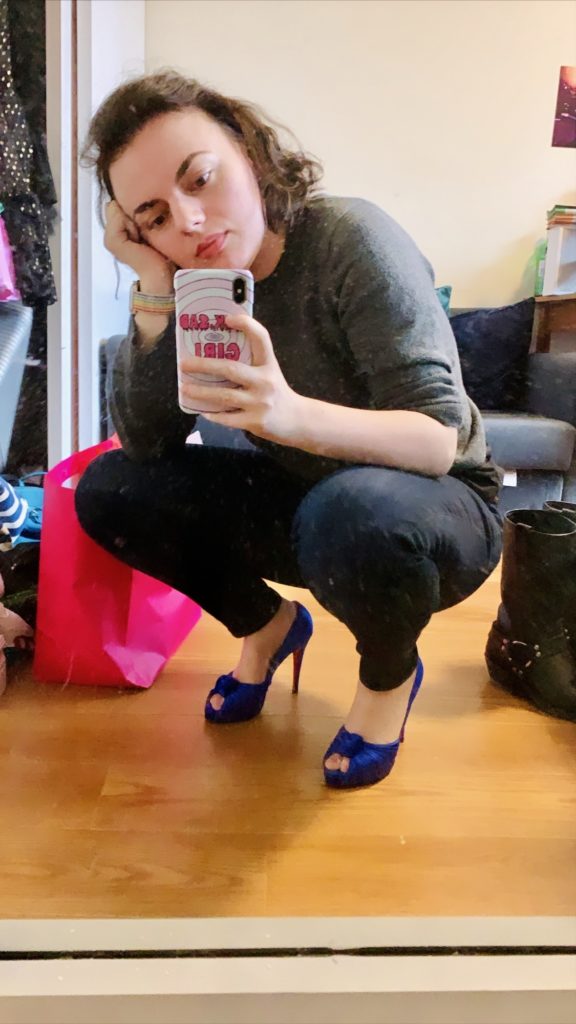
How I Found a Kink-Positive, Polyamory-Savvy Therapist

A couple months ago, I decided I was tired of carrying around years-old trauma baggage, and wanted to start working through some of it. Blessedly, I also found myself in a stable enough financial position that, for the first time in my life, I could afford to see a therapist whose fees were not handled by the Canadian government. It was time.

I ended up finding a really rad person who is very much equipped to handle the exact problems I intend to work on. But as you may know, that can be super hard to do if you are – like me – queer, kinky, and non-monogamous. Finding a practitioner with a working knowledge of these topics – let alone someone who has lived experience in these communities – is way harder than it should be, as evidenced by the number of people who have said to me, “I’m so jealous! I can’t find a good therapist!” lately when I’ve relayed this news.

So, in the hopes of being helpful, here’s the process I went through to find my current therapist. Best of luck!

Step 1: Figure Out Your Priorities

Granted, when going through times of psychological distress, we don’t always know exactly what is causing the turmoil we feel, or what kinds of approaches might help. But if you have any sense of the therapeutic modality(/ies) you’d like to explore, that’s good to know, as most therapists have particular methodologies they like best and know the most about. I knew, for example, that I wanted someone who knew a lot about the somatic effects of trauma. I knew, too, that cognitive-behavioral therapy hadn’t been particularly helpful for these issues in the past, so I wanted someone who didn’t rely too much on that modality. And I knew I wanted someone who would push me toward actual action and change, instead of just listening to me and affirming my feelings (which is great, but not enough in my case).

I also knew that whoever I chose would have to be reasonably knowledgeable about queerness, kink, and non-monogamy (as those are pivotal parts of the traumas I wanted to examine, and of my life itself), as well as gender (since my partner is nonbinary and many people I love fall under the trans umbrella). These things were non-negotiable because a lot of my roadblocks with previous therapists had come from them having little to no experience with clients in these communities and mostly just asking me, “What do other queer/kinky/polyam people do in your situation?” which, as you can imagine, wasn’t all that useful for me.

Step 2: Filter & Search

There are several websites dedicated to cataloguing therapists who work with various subcultures and marginal communities; Poly-Friendly Professionals is one, for instance, and so is Kink-Friendly Therapy. However, I wasn’t able to find as many practitioners in my geographic area on these sites as I wanted to. (If you live in a large U.S. city, your results might be different.)

After a little Googling, I discovered that PsychologyToday.com lets you search for therapists in your area and filter them by the issues they say they’re best equipped to handle (e.g. trauma), the modalities they use (e.g. somatic), and – best of all, for people like us – the communities they say they’re allied with (e.g. gay, transgender, kinky, non-monogamous). This is a total game-changer.

I narrowed down my search with a few filters and then opened a zillion tabs of different therapists’ pages so I could have a closer look at each of them. Most profiles on the site contain information about the practitioners’ degrees and certifications, how long they’ve been practicing, and what their rates are. This ought to give you a much more specific sense of which people are well-suited to you and which aren’t.

Step 3: Narrow It Down

Because I’m a nerd, I made a spreadsheet on Google Sheets of the top contenders from my PsychologyToday search. Its columns included: name, accreditation(s), rate, modalities, relevant identities (i.e. are they themselves queer/kinky/non-monogamous?), poly competency, trauma competency, and suggested next steps (i.e. whether their profile said they offered an introductory consultation call for new potential clients). This helped me see the bigger picture and eliminate some folks who didn’t seem like an optimal fit for me.

I sent out about 10-15 emails to therapists that fit the specifications I was looking for, and explained the issues I wanted to work on. Then I waited for their responses. Some never answered at all; some told me they weren’t accepting new clients at the moment; some wrote vague emails saying they thought they could handle what I’d asked about, without actually acknowledging the words of what I’d said.

Ultimately, the therapists who stood out to me were the ones whose replies specifically mentioned the issues I’d brought up, and related those issues to their own therapeutic approach(es). I also paid attention to how I felt when reading these emails, because a therapist’s “vibe” can be an important clue as to their potential compatibility with you.

Step 4: Consultations

Most of the therapists I contacted offer a free 15- or 20-minute consultation call (via phone or video chat) so the two of you can get a sense of each other and figure out whether you’ll be a good fit. I scheduled 3 of these calls, with the 3 most promising prospects from my shortlist: therapists who seemed confident they could handle my issues and whose rates were affordable for me.

In those chats, each therapist told me a bit about themselves and how they approach therapy. They allowed me to ask questions about their modalities of choice. I also made sure to ask them about their levels of experience, knowledge, and comfort around kink, queerness, gender, and non-monogamy, because – sadly – writing in your profile that you’re savvy about those things doesn’t necessarily mean that you are. I specifically brought up Daddy Dom/little girl kink in these conversations, because it’s a central part of my life and I know that some people are squicked out by it, so I wanted to make sure it would be okay for me to talk about it. It was also important to me that my new therapist avoid blaming my kinks on my trauma, or stigmatizing/pathologizing my kinks (the world does enough of that already!), so I made sure to mention that specifically.

When I talked to the therapist I ultimately ended up going with, I noticed she was listening to me very closely and would mirror my sentiments back to me in a way that felt very affirming. She also told me that she had lived experience with non-monogamy and non-normative genders, and that she’d worked with kinky clients and had a good understanding of kink but was not kinky herself. It was a mix of these more practical considerations and an overall good vibe that made me decide I should start seeing her.


I hope this helps you! Feel free to let me know in the comments if you have any tips of your own for finding therapists who are competent in these areas, or other niches/subcultures.

Book Review: The End of Policing

Here’s one of the whitest things I could possibly say: I’ve never had a memorable encounter with a police officer.

Unlike countless people of color and especially Black folks, I have never been harassed, victimized, pursued, or discriminated against by a cop. My opinion on the police for most of my life has been neutral-to-positive, a fact that makes painfully clear the effectiveness of “copaganda”: media created to sugarcoat and valorize the role of police in our society. From SVU to Brooklyn Nine-Nine to The Silence of the Lambs, much of our media serves to numb white people’s understanding of the havoc cops wreak on Black folks’ lives every day, and have since the birth of their institution.

It was for this reason that I felt compelled to read The End of Policing. Friends of mine more entrenched in the social justice movement than I am have been shouting (and tweeting) anti-cop slogans for years now, and – seeing the violence regularly inflicted on marginalized people by police officers – I agreed with them that something needed to change. But I didn’t know much about the nuts and bolts of the issue: law enforcement’s rampant history of racist profiling and unwarranted violence, and the alternatives being proposed to replace this frustratingly venerated institution. My privilege had enabled me to go a long time without investigating this issue beyond a few cursory Google searches and news articles, but I wanted to fix that, because information is power and can effect change. So when I saw that Verso Books was offering a free ebook of The End of Policing for a while, as per the author’s wishes to get this information out there, I snapped it up and started reading.

It’s worth noting that the author, a sociology professor named Alex S. Vitale, is (so far as I can tell) white. Some books written by authors of color on similar issues include How to Abolish Prisons by Rachel Herzing and Justin Piché and Are Prisons Obsolete? by Angela Davis, both of which I’d like to explore next because they focus more on the imprisonment part of the unjust law enforcement system, while the book I’m reviewing today is all about cops: what they do, where they go, how they operate, and why they’re ill-suited for the roles we’ve slotted them into.

Vitale’s central argument is that the entire way our culture understands crime, and its causes, is wrong. There’s a hugely prevalent “bootstraps” theory of crime that paints it as the behavior of the depraved and morally flawed. Why would someone steal a loaf of bread, this theory goes, unless they were an ethical degenerate? What is there to do for them but throw them in the slammer, give them a shot at self-rehabilitation, and then toss them back out onto the streets when their sentence is done?

This perspective completely ignores the existence of structural inequality – which, newsflash, is a pretty big component of any capitalist society. When you make a law that says “stealing is wrong” (for example) but you put one group of people in a situation where they regularly have to choose between stealing and dying, while another group of people rarely or never even gets close to the maw of that terrifying decision, of course the first group is going to get in legal trouble constantly. And because our culture works how it does, that group – poor folks, and especially poor Black and Brown folks – will be treated as if their thievery was an independent decision based on a moral failing, rather than something they were pigeonholed into doing by the way the world treats them.

I’d heard it said many times in social justice circles that the police’s purpose and function is essentially to keep Black people down, and I always thought that was a claim about the police’s current atrocities rather than an indictment of the institution’s entire foundation and original purpose. But Vitale’s book set me straight on this issue. Police – which haven’t existed in their current form for as long as you might think – were always assembled and deployed with the mission of protecting people who had money, power, and privilege. They would chase down slaves who escaped, for example, and squash workers’ rights movements on behalf of the upper-class whites who didn’t want to have to give their poor employees better working conditions or higher pay. Police, both historically and presently, put a higher premium on protecting white people’s “property” and “wealth” (which, let’s not forget, was stolen from Indigenous folks and built by BIPOC’s slave labor) than on protecting Black people’s lives.

Seeing as their entire institution was literally created for this purpose, it’s no surprise at all that they continue to be one of the most racist forces in a world some people still misguidedly insist is “post-racial.” This is especially true since, as Vitale explains, police are trained (whether explicitly or implicitly) to view perpetrators of crime as their enemy in a war of sorts, so they come to view themselves as heroes when in fact they are usually targeting society’s most vulnerable at the behest of society’s most powerful.

This main idea – that the solution to crime isn’t stricter law enforcement, but instead, the end of structural inequality – echoes through every chapter of Vitale’s book. He looks at topics like sex work, border violations, homelessness, drug use, and street gangs, and systematically explains why police are not a good or even passable solution to most problems. Structural inequality, the likes of which we see between white folks and people of color in North America and elsewhere, leads to economic precarity and, in many cases, mental illness and addiction issues for those who get the short end of the stick. These factors are the roots of almost all the crime police crack down on, and yet the crimes themselves are treated as isolated incidents, related to nothing structural except the supposed moral decrepitude of the “criminal” class. Why are we surprised that we built a dam and now the water is overflowing?

Each chapter of Vitale’s book gives an overview of the area of policing it covers, including numerous horrifying statistics and stories, and then offers some alternatives to the police-based status quo. You’ve probably seen people talking about some of these alternatives on social media a lot lately. Because the law enforcement institution is deeply discriminatory and was built to be that way, reforms aimed at getting the police to behave better will never work. It’s like training a bloodthirsty animal not to eat meat: the best you can hope for is that they’ll successfully suppress their natural desires for a while, not that those desires will actually change. For this reason, police abolitionists – a group that, wonderfully, seems to be growing by the day now – want, instead, for the police to be defunded and for those funds to be reallocated to services and causes that will actually reduce crime, like affordable housing, mental health counselling, addiction treatment, employment programs, social work, and sex work decriminalization. The law enforcement system thinks the best way to reduce crime is to make life harder for those in vulnerable populations; Vitale’s perspective, and that of other police abolitionists, is that making life a great deal easier for those people is the true ticket to crime reduction and a more harmonious society.

One thing that astonished me to learn from this book is that these alternatives are usually much cheaper to run than the current law enforcement system. Vitale produces stats that back this up for a staggering number of issues. It turns out, for example, that it costs the state dramatically less to just give a homeless person a safe and stable place to live for free than it would to continually cycle them through jails and courts for the “crime” of sleeping in a park or urinating on the street. (Where else are they supposed to sleep and pee, when you’ve banned them from so many safer locations?) It would also reportedly be cheaper to supply addicts with treatment and harm-reduction services than it is to send them to drug courts or prison. The tired Republican argument of “Where will the money come from?!?” seems pretty weak when you realize that police budgets are often the highest line item in any city budget and can be billions per year. Do you actually care about “the taxpayers,” or do you just hate the marginalized people you see as intractable criminals?

While this post is ostensibly a review of The End of Policing – which I loved, and would heartily recommend – mostly I wanted to use my platform here to tell you what you can do if you believe enough is enough and the police should be defunded. You can call or write to your local political leaders to demand they take action on this issue. You can donate to, and signal-boost the work of, abolitionist activists and organizations like Critical Resistance. You can loudly question the dogmatic beliefs of your police-abiding friends and family, perhaps backed up by stats and facts you read in this book. You can educate yourself more and more on this issue until you flush the harmful “copaganda” out of your psychological system. I’ve been doing all of these things after a lifetime of relative ignorance on this issue, and I invite you to join me – because contrary to popular belief, if we truly want a safer world, we need to get rid of cops and replace them with actual solutions to the problems we face.

5 Pandemic-Friendly Kinks to Play With While Quarantining

I don’t know about you, but watching a dramatic worldwide crescendo of racism and transphobia play out against the backdrop of a global pandemic doesn’t exactly make me horny. I’m sure that’s quadruply true for the people of color and trans people directly affected by the tidal wave of bullshit enveloping the world right now.

And yet… particularly for those of us who are highly sexual people and/or sex nerds, pursuing pleasure through sex can be one of our major methods of escapism, right alongside Netflix marathons and Animal Crossing sessions. I’ve been lucky enough to have my partner quarantined with me for the past 3 months, but they can’t and won’t stay forever, so I’m mentally preparing myself for the need to take my sexuality into my own hands once again. In stressful times such as these, getting creative can be an important component of that.

The good news is that even solo sexual creativity is easier than ever in the internet age. Online, we can theoretically order sex toys and sex furniture to satisfy our every kinky whim – and we can also learn about proclivities we may never have otherwise heard about, and start incorporating them into our fantasy lives. Here are some suggestions that work surprisingly well in a COVID-wracked world…

Mask Up

As a recent NYC Health brief on safer sex in the time of coronavirus helpfully noted, wearing a face covering or mask during sex is one way to practice harm reduction when hooking up these days. However, even if you’re rollin’ solo, a mask could be an interesting addition to your kinky imaginings. As you’ve probably already noticed while walking around with a mask on, these useful pieces of fabric make it slightly difficult to breathe… kinda like a lover’s hand clamped over your mouth and nose in a breath-play scene. This effect could make a mask a hot addition to your next masturbation session – just be safe, okay? Take the mask off if you start to experience any genuine discomfort or difficulty breathing. And wash that thing before you wear it out into the world again, incase you got any, uh, droplets on it.

Undercover Ballgag

Speaking of masks, it occurs to me that these days you could potentially wear a ballgag outdoors completely unnoticed under your mask, particularly with the creative usage of a hat or somesuch to cover any telltale straps. Only do this if you know you won’t need to interact with anyone at any point – maybe on a meandering walk on side-streets while listening to a kinky podcast. I’d suggest the type of ballgag that has holes in it for easier breathing, since – as we’ve discussed – masks already make that difficult. Don’t overdo this one, because you don’t want to injure your jaw, but if you’re craving some public humiliation/submission, this could be a cool way to make that happen without necessarily involving any non-consenting third parties.

Creepin’ and Cammin’

We’ve already talked about exhibitionism vis-à-vis quarantine, but my friend Bex had such a great idea about this on a recent episode of our podcast that I wanted to share it here too. With the proliferation of Zoom calls and FaceTime chats these days, it’s easy to imagine a roleplay scenario with a partner in which you “accidentally” forget to disconnect at the end of a call, and the person on the other end is able to creepily watch while you get undressed, or jerk off, or fellate a sex toy, or… whatever else you like to do to decompress after a draining video call. This is a cool way to play with the idea of a “peeping tom” without either of you having to leave your homes.

Hygiene Humiliation

In just the few months since COVID popped off, I’ve noticed it’s shifted the way I view media. I’ll be watching a party scene from a 1960s sex comedy, or a friend-hang at a crowded bar in a ’90s sitcom, and I’ll feel myself momentarily overcome with medical anxiety – “Aaahh, get away from each other, you’re not standing 6 feet apart, you fools!!” It occurs to me, though, that this same impulse could be harnessed for all sorts of humiliation-based fantasies. Maybe your domme orders you to give yourself a harsh spanking for only washing your hands for one Happy Birthday, not two… or you have to scour every doorknob and cabinet handle with Lysol and an old toothbrush… or you get your mouth rinsed out with soap for breaking one too many public health guidelines. (Listen to the recent episode of the Off the Cuffs podcast entitled “Rub A Dub Dub” for tips on mouth-soaping!) Whatever you do, make sure all your “violations” occur only in your own home, or even just within your fantasies – humiliation is hot but it’s not worth spreading disease for, obvi.

Ghostly ‘Gasms

Have you ever heard of spectrophilia? It’s a fetishistic interest in spirits or ghosts (or the idea of them, anyway). Some folks in this community claim to have actually hooked up with a ghost, or perhaps several; I’ll let the Mythbusters handle that one, but even if you don’t believe in the paranormal, it could be fun to do a spectrophilic scene with your socially-distanced sweetie. If you put them on speakerphone and position your phone such that your lover’s voice seems to be emanating from the walls or from the depths of your closet, you can create the illusion that there’s a pervy, voyeuristic ghost creeping on you while you masturbate. Fear play isn’t everyone’s jam, but it could be a nice make-believe counteragent to the very real fears pervading the globe right now!


What COVID-appropriate kinks have you been playing with lately, if any? (“None” is a completely valid answer… Reading the news these days isn’t exactly an aphrodisiac, to say the least.)


This post was sponsored. As always, all writing and opinions are my own.

Got Chronic Pain But Love Giving Handjobs?

I remember the first time I realized my chronic pain disorder might seriously mess up my sex life. I was kneeling in front of a dominant gentleman friend, sucking his cock while he tugged at my hair, when a telltale twinge of pain began to creep up in my knees. They were, at that time, my most painful and volatile body part – and blowjobs were, at that time, my most beloved and calming sex act. I shifted around, tried putting a pillow under me, tried sitting on my ass instead, but it was a lost cause. My knees had cockblocked us both. Defeated, I finished out the encounter with a handjob.

Handjobs have long been one of my favorite things to do to a partner, so this wasn’t exactly a consolation prize, at least for me. But in recent years, pain in my hands has plagued me even more than pain in my knees. It’s a bummer to realize that the sex act I once turned to when I was in too much pain to do anything else is now sometimes off-limits to me due to pain.

Fortunately, I’ve always had partners who were very understanding about this issue. They’ve typically been fine with me cuddling up to them and kissing their neck while they jerk themselves off, or playing with their nipples while they fuck a Fleshlight. But as any handjob-giving aficionado will tell you, sometimes the joy in acts like these isn’t just about observing your partner’s pleasure, but in directly causing and controlling it. And in that regard, there was only so much I could do.

So when a company called Handy emailed me about their new product, I was intrigued. Designed by a Norwegian engineer, the Handy is an electrically-powered mechanical stroking device, much like the unfortunately-named Sybian Venus for Men – but it only costs $169, while the Venus costs a whopping $956. Okay, Handy; I’m listening.

To be fair, the two products aren’t really as comparable as I initially thought: the Venus is custom-constructed to fit your exact dick measurements, and uses different mechanics to create a sensation I have to assume is pretty different from the Handy’s. But if using a Venus is on your bucket list despite clearly not being in the cards for you financially, maybe the Handy would be a good substitute.

So what is this toy? It’s a somewhat clunky, Fleshlight-shaped mechanical cylinder attached to a fabric band which you can wrap around an included masturbation sleeve (of unknown material, though probably some kind of thermoplastic rubber/elastomer, and definitely porous – ergo, don’t share it with anyone you’re not fluid-bonded with). The band moves the sleeve up and down over the penis once it’s inserted, and you can use the 4 buttons on the Handy to control the speed of each stroke as well as the length of the stroke.

Setup is slightly annoying, as you have to keep adjusting the tightness of the band with its Velcro strap depending on how hard your dick is and how much pressure it’s craving at any given moment. But if you’re already pretty hard and aroused by the time you start using it, that might be less of an issue. Lube is also an ongoing consideration, as with just about any penile masturbation toy; the company recommends water-based only, and you may need to reapply during use, especially if your session runs long.

What I love about this toy, as a “handjob top,” is how much control it gives me. When I use my hands on a partner’s cock, I’m not just altering the speed, I’m also altering the length and location of my strokes – so I’m glad to have a toy that can approximate that, however clunkily compared to the nuance of skilled hands. The “left and right” buttons on the control unit are for speed, and the “up and down” buttons control the stroke length; everything is close together, so I barely have to move my hand or expend any muscle energy when I’m using this toy.

One small complaint is that it’s difficult to know exactly what to do during a partner’s orgasm. When using my hand, normally I would either hold still while maintaining pressure, or slow down and lengthen my stroke quite a bit for the duration of the orgasm; when post-orgasmic hypersensitivity hits, it’s easy to remove your hand quickly, but it’s trickier to do that with the Handy. You can hit a bunch of buttons to swiftly slow the toy down, but removing it from the dick in a rush is likelier to cause more discomfort than just leaving it in place would. However, this’ll only be a minor issue for most people, and some might even like it if they enjoy an overload of sensation.

Cleaning is also an annoyance, but that’s true for pretty much every stroker/masturbator. Resist the temptation to fall asleep in a post-orgasmic haze, and make sure to rinse the cum and lube out of the stroker within a few minutes after using it, or you’re in for a gunky, moldy surprise later on.

If this were a standard review, I would touch on the video synchronization and smartphone-control features of the Handy, and I’m sure that they would help folks whose hand pain is even more severe than mine. But for my purposes, I prefer to get as close to hands-on as I comfortably can, so physically holding the toy works better for me.

Overall, if you have pain/mobility/strength issues in your hands and would still love to be able to give handjobs (or jerk yourself off), I think the Handy is a worthy investment. The band-and-sleeve system makes it so that you could theoretically swap out the provided stroker for a different one, if there’s another texture or size you prefer. You can therefore get more variety of sensation out of this toy than many other comparable ones, especially considering the flexibility of the controls scheme. $169 is a bit steep for some people’s budgets, sure, but I’ve never seen a toy of this type and caliber sold for any less – so when fellow sore-handed people ask me how they can keep on strokin’ dicks, now I know to recommend the Handy.


Full disclosure: Handy didn’t pay me for this review, but they did send me the product to try (thanks!) and I do get a small kickback if you buy through my affiliate link. Want more sex toy recommendations for folks with chronic pain? I wrote this article recently for Xtra on that very subject!

5 Ways to Unlearn the Anti-Black Whorearchy

Remarkable photo by Scarlet Harlot

Racism and sex worker rights are two issues at the forefront of my mind these days, as my social media feeds overflow with white supremacist police violence, loss of income for many due to COVID-19, and the continuing fallout of the whorephobic SESTA/FOSTA laws that make life more difficult for people whose lives were already pretty damn hard.

Recently I listened to a lecture Tina Horn posted to her Why Are People Into That? podcast feed on the topic of the whorearchy – which I knew existed, but hadn’t thought about in much detail before. For those who don’t know, the whorearchy is the abhorrent sociocultural system of biases by which sex workers can be ranked into a hierarchy and then judged based on their place in it. “Trashier,” “sluttier,” more dangerous and/or more stigmatized forms of sex workers tend to end up near the bottom – strippers and street-based escorts come to mind – while those seen as “classier” or less directly/physically involved with their clients tend to be ranked near the top – think webcam performers, sugar babies, and phone sex operators.

While obviously this paradigm is classist, slut-shaming, and whorephobic, it can often be overlooked that it’s also racist, and specifically anti-Black. Clients and fellow sex workers alike can have both overt and covert racist views that affect how Black sex workers are perceived and treated, and what price they can command. As a white person who only dabbles in sex work here and there, I’m going to pull from writing I’ve read from Black women and sex workers, including Daniella Barreto, Jasmine Sankofa, Terri-Jean Bedford, and more, to recommend some ways you can work to unlearn and oppose the anti-Black whorearchy you’ve likely internalized.

Learn about the labor involved in different kinds of sex work.

There seems to be a common sentiment among those who harbor unexamined whorephobia that certain types of sex work are “easy.” This is why, for example, sometimes privileged women will joke that they’ll “just get a sugar daddy” or make an OnlyFans account when they have a few extra bills to pay, as if these roles are easy ones to slip into and start making money from.

In reality, just about every sex worker out there – from a camgirl in her Toronto basement to a stripper in a sticky-floored New York club to the finest luxury escort London has to offer – puts in waaay more work than you probably think. Marketing, grooming, skill-building, fitness maintenance, client relations… These things take a hell of a lot of effort and time. Researching what’s actually involved in the different kinds of sex work – especially the kinds you view, consciously or less so, as “trashy” or “low-class” – will avail you of those misconceptions pretty quick. (Make sure you’re reading accounts written by actual sex workers!)

Shift your language.

I’ve stopped using the word “whore” the way I used to – as synonymous with “slut” – because I’ve learned from sex worker activists that it’s a term used historically to slander and stigmatize sex workers, and thus only they can choose to reclaim it for themselves. Similarly, “ho”/”hoe” is a derivative form of this word which comes from African-American Vernacular English (AAVE) and thus isn’t for white people’s use. (This is just my understanding; those in the know can feel free to correct me on this if I’m wrong.)

There are lots of unsavory slang terms for various types of sex workers, and many of them have a racist tinge (to say the least). If you’re not sure of the best terminology for a particular type of work or worker, look to the writings of the people doing that work and see which terms they prefer and why. Then, commit to shifting the language you use when you talk about these issues.

Write to your political leaders about SESTA/FOSTA.

The laws known as SESTA/FOSTA were ostensibly created to prevent sexual trafficking – but in practice, they’ve mostly just deepened the existing issue of sex workers being unable to safely advertise and conduct their work, online or off. As with pretty much any issue involving legal repercussions or financial disempowerment, this has hit Black sex workers particularly hard, since (as the news lately has loudly echoed for us) the law enforcement system is hugely racist, and Black folks are likelier than white folks to struggle with economic lack and uncertainty.

For this reason, as Amnesty International USA has argued, sex work decriminalization is a racial justice issue, among other things. Write to your political leaders to demand they work to repeal SESTA/FOSTA – or whatever other anti-sex work laws exist where you live. Many people’s lives and livelihoods depend on it.

Call out whorephobic comments when you hear them.

When I was a kid, there was a strip club in my neighborhood, so we drove by it fairly often. My parents were fortunately chill about it, but I often saw people laughing, pointing, and staring at the signage when they walked by, as if the very idea of a stripper was something to be mocked and belittled. People make whorephobic comments all the time, in a wide variety of ways – many of which are subtly or not-so-subtly racist – and a small thing you can do to fight against sex work stigma is to push back when you hear those comments being made.

While some prefer a more direct or aggressive approach, I usually like to respond to these comments calmly, with facts. When someone pityingly or disgustedly describes sex work as “selling [one’s] body,” for example, I like to point out that tons of other workers – including athletes, massage therapists, dancers, and actors – also make money from the ways they use their bodies. Sometimes the simplest rebuttals and reframes can help someone look at sex work in a new light.

Follow more Black sex workers on social media.

The fastest way to comprehend a group of people you don’t know enough about, in my experience, is to surround yourself with those people and listen to them. Even if you don’t think the anti-Black whorearchy informs your perspective, it probably does – and you can shift its insidious influence over time by just spending more time reading the thoughts, opinions, and work of Black sex workers.

I need to do better at this, myself – most of the sex workers I follow are white, so I know I’m only getting a limited view of the industry and the problems within it. The @BlackSexWorkers account is no longer active, but its Following and Followers lists look like a good place to start. Feel free to recommend folks to follow in the comments if there are any Black sex workers you find delightful/enriching to follow!


This post was sponsored. As always, all writing and opinions are my own. I donated $50.00 USD/$70.00 CAD of my sponsorship fee for this post to the Black Sex Worker Collective; feel free to match me if you have the means!