10 Ways Vibrators Can Be Therapeutic (+ a Giveaway!)

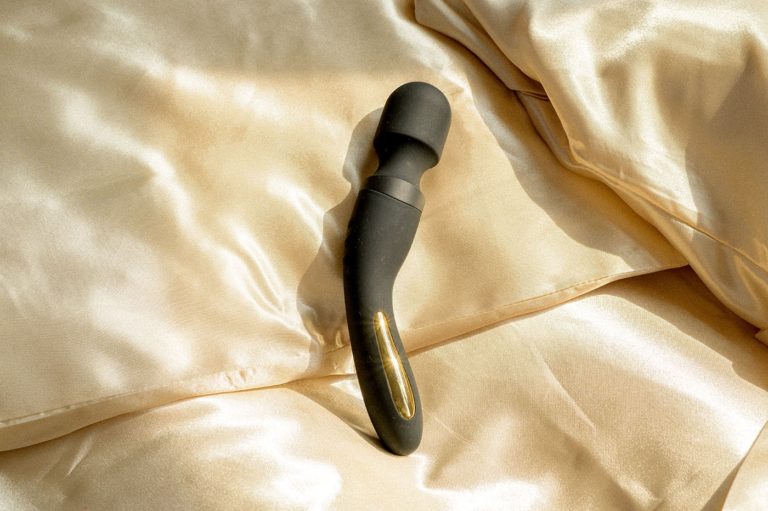
Photo via Bellesa

It would be easy to think, comparing my work to that of my journalism-school colleagues now reporting on business and politics, that what I do is comparatively frivolous. Sex writing is, after all, largely about fun and pleasure – or at least, that’s how it’s often perceived from the outside. In reality, many people writing about sex today delve into hugely important sub-topics of that realm, like health justice, trauma, education policy, and gender inequality. Sex is no small thing, and it never has been.

That’s why today I wanted to highlight for you 10 ways that people use vibrators therapeutically. As with all medical suggestions you read online, you should run these by your doctor and/or therapist before trying them – and if you do, I hope you find them helpful!

Toning the pelvic floor

Pelvic muscle contractions, the likes of which are experienced during orgasm and high levels of arousal, strengthen the muscles they employ. These muscles’ fitness is responsible for longer and stronger orgasms, yes, but also for preventing pelvic health issues like urinary incontinence.

Healing from trauma

My friend Sarah Brynn Holliday has written about how sex toys can be instrumental in rediscovering pleasure after sexual trauma. A sex toy you know well is controllable in a way that human partners are not, so when you need or want to control your sexual experience to avoid triggering or re-traumatizing yourself as best as you can, sex toys can be helpful.

Alleviating menopause symptoms

For some people, menopause causes the onset of “vulvovaginal atrophy,” wherein decreased estrogen levels in vaginal tissue cause the vagina to become dry, irritated, and sore. The vaginal walls may become thinner, leading to painful sex, especially sans lube. Gynecology professor Dr. Mary Jane Minkin told the Huffington Post in 2013 that vibrators stimulate increased pelvic blood flow, potentially alleviating these symptoms. Some of the menopausal women in my life have also found it psychologically helpful to masturbate more as they age, since our culture tends to harmfully frame older women as unsexual and unsexy (boooo!).

Managing depression

This is a big one for me. It doesn’t always work, but sometimes administering an orgasm through the use of a vibrator can kickstart the production of some happy neurotransmitters and thereby lift my mood. This is especially helpful given that, in the throes of a depressive episode, I often find my own genitals unsettling to touch – so it’s a godsend to be able to hold a vibrator against my pajama pants and get off without grossing myself out or upsetting myself further.

Massaging muscles

We all know about this one – especially since the famous Magic Wand Original (née Hitachi Magic Wand) was developed for sore muscles. This way of using vibrators has become particularly important to me since I developed chronic pain, and I’m so glad it’s an available option.

Increasing desire

There seems to be a “horniness begets horniness” effect at work in many people’s sex lives. It’s what sex researcher Emily Nagoski refers to as “responsive desire,” which she affirms is a normal way of experiencing your sexual appetite, despite the medical community’s historical insistence on misdiagnosing this as “hypoactive sexual desire disorder” or straight-up “frigidity.” In any case, if your sex drive is lower than you would like it to be, regular usage of vibrators is recommended by some doctors to boost your libido. Worth a shot!

Pleasure after injury

Several studies, for example, have noted vibrators’ ability to provoke sexual response even in people who have sustained spinal cord injuries that otherwise inhibit their sensitivity and functioning. This seems to be discussed most often in the context of obtaining semen from disabled men so they can father children, rather than in the context of pleasure or satisfaction, but its implications are encouraging nonetheless.

Combating vaginismus

Vaginismus is a vaginal pain condition in which involuntary pelvic muscle spasms make penetrative sex extremely painful or outright impossible. Vaginal dilators of steadily increasing size are one oft-recommended intervention for vaginismus, and these pair well with vibrators, both because vibration helps muscles relax and because pleasure can gradually overwrite the patient’s mental associations between sex and pain.

Mending relationships

Granted, a vibrator alone is not going to solve your relationship problems – interpersonal connections have too many complex layers for “quick fixes” to do any good. But if, for example, one partner has trouble relaxing into pleasurable sex due to stress in their life, or someone’s inability to orgasm has become a point of friction in the relationship, or your sexual connection has simply grown stale and rote, the addition of a vibrator could help. There will be other mental/psychological/interpersonal work to do, too, but you’ve gotta start somewhere. (Just please don’t buy a vibrator out of the blue for a partner who has never expressed any interest in owning one. This is coercive, presumptuous, and weird!)

Post-breakup self-care

For me, the saddest part of a breakup is always the idea that not only have I lost the love/companionship/pleasure I achieved with my ex, but also that I might never find those things again with anyone else. This is obviously bullshit, but it’s a very persuasive idea to a grieving brain. Vibrators have always helped me at this time: I know that even if my latest paramour has fucked off, I can still make myself come, and that’s powerful. It’s sometimes the first step toward rediscovering my own strength, resilience, and potential.


If, after reading all that, you’re thinking, “I’ve gotta get me a vibrator,” you’re in luck – the fine folks at Bellesa are offering up a Nirvana wand vibrator for one lucky reader in North America! Bellesa focuses on making sex toys for women, but of course, anyone of any gender and body type can use a vibrator, especially one as versatile as the Nirvana. It’s a rechargeable, waterproof, silicone wand vibe, and you can use it on any external erogenous zone that enjoys vibration. Yay!

Here’s how to enter: 1) follow @BellesaCo on Instagram, 2) follow me (@Girly_Juice) on Instagram, and 3) leave a comment on this Instagram post of mine answering the question “What’s one way you think vibrators can be therapeutic?” and tagging a friend. The giveaway will run for a week, and then I’ll pick a random winner. Please note that you must be over 18 and must live in North America to win. Good luck!


This post was sponsored. As always, all writing and opinions are my own.
An Erotic Hypnosis FAQ

Of all the kinks I’ve explored in my diverse and storied sex life, I think hypnokink is one of the ones I get the most questions about. Sometimes people seem flummoxed when I mention it, as if they had never even considered that hypnosis could be perverted into a sex act – and I don’t blame them, because I didn’t really know it was a thing either, before I did it!

I’m no hypno expert – you should look into the work of Mark Wiseman, Sleepingirl, Mr. Dream, Lee Allure, and DJ Pynchon if you want info from more experienced people – but here, nonetheless, are the answers to some of the most common questions I get asked about hypnosis.

Q. What is hypnosis?

A. The way I understand it, hypnosis (or hypnotism) is the process of bringing someone into an altered state (trance).

Q. What is trance?

A. Much like subspace, being drunk/high, or being in “flow state,” trance is an altered state that can change how you speak, how you behave, and how you perceive stimuli. Trance is characterized by hyper-focus, though it may not look like that from the outside. Someone who is in trance is often more suggestible than they would otherwise be, which makes it a useful state for kink games.

Q. What does trance feel like?

A. It’s important to emphasize here that 1) trance feels different for different people and 2) it may not feel like what you’d expect it to feel like. You will have a better hypnosis experience if you’re able to release all preconceived notions about what trance “should” feel like and just remain present and focused on what you are feeling.

That said, for me, trance feels a lot like those calm, still moments between sleep and wakefulness, or like being super stoned but still lucid. My thoughts come more slowly, and there are fewer of them. It’s often hard for me to speak or move when in trance. My eyes fall closed and my body goes slack. I can still perceive and understand what’s happening around me, but am particularly focused on the voice of my hypnotist and have, to some extent, the ability to tune out other stimuli. It’s a warm, pleasant, heavy feeling, like being really sleepy in a big comfy bed.

Q. Afterward, do you remember what happened while you were in trance?

A. For the most part, yes. It can be like subspace in that sometimes my memory will be blurry or will need to be jogged if I’m going to recall the scene. But unless specifically instructed to forget something (a potentially risky practice called hypnotic amnesia), I typically have no problem remembering what happened.

Q. Can anyone be hypnotized?

A. There are some neurological conditions which may make trance difficult or impossible to achieve – usually conditions which affect one’s ability to focus. However, most people can be hypnotized.

Q. Can a hypnotist make you do things you don’t want to do?

A. As Sleepingirl and GleefulAbandon point out in their excellent zine about hypnosis myths, the idea of hypnosis as mind control isn’t right but also isn’t completely wrong. While your trancey brain will often naturally fight against following orders you genuinely don’t want to follow, it is still possible for someone to use hypnosis to sway your behavior in ways that may go against your will. That’s true for lots of kinks: if I trusted a dominant, for example, the intoxication of subspace could make me do things they told me to do during a scene, even if those things hadn’t previously been negotiated or agreed to. As with any kink activity, hypnosis scenes should be thoroughly negotiated beforehand, and you should use your best judgment in selecting partners you think are trustworthy.

Q. How can I learn hypnosis?

A. If you want to be a hypnotist (also known in the community as a top or a ’tist), I would strongly recommend picking up Mark Wiseman’s book Mind Play. It’s a great primer on the whys and hows of erotic hypnosis, and you will be able to at least attempt to hypnotize someone after reading it. There’s also a reading list on Mr. Dream’s FetLife profile that you’ll find helpful.

If you’re only interested in being a hypnotic subject (also known as a bottom or a hypnotee), I still think you should read Mind Play to get a sense for how hypnosis works and what it can be used for. There’s even a section in Mind Play that teaches you how to hypnotize yourself. There are also tons of sex workers and content creators who offer hypnosis videos and audios – Priestess KatherineAlicia Fairclough, Gently Bitten, and Tennfan, for example – though it should be noted that these aren’t a perfect substitute for “the real thing” with a partner, because, like sex, hypnosis works best when all participants involved are present, paying attention, and tailoring their approach to the person or people they’re with.

Q. How did you get into hypnosis?

A. I was vaguely aware of erotic hypnosis before meeting my current partner mb (a fuckbuddy once tried to induce an orgasm in me using hypnotic-ish techniques, much to my amusement and chagrin), but I never tried it until I started dating them in 2017. It was a major kink of theirs – which they disclosed to me sometime between our first and second dates – and it immediately piqued my interest because of how it could potentially be combined with D/s. We did our first hypno scene by accident (!) and the rest is history.

Q. Is it hot?

A. There are lots of people for whom the hot thing is the hypnosis itself. Maybe being in trance turns them on, maybe seeing someone else going into trance turns them on, maybe hypnosis tropes in TV and movies turn them on, maybe all of the above! As with many fetishes, hypnokink isn’t always easy to explain to people who don’t have that kink. Either you get it or you don’t.

That said, you don’t have to have a hypno fetish to find erotic hypnosis sexy. I (and many others) find it hot for reasons other than the trance itself: for example, the power dynamics at play, the sensory effects hypnosis can induce, and the way a skilled hypnotist can quiet my anxious mind to allow for greater heights of relaxation and arousal. If you eroticize control – controlling someone, being controlled, or both – then hypno can be a really fun and unique way to play with that.

Q. What kinds of things can you do in a hypno scene?

A. Again, check out Mind Play for a list of ideas, as well as Lee Allure’s list. Some things I’ve done in the past: altering the intensity or location of sensations (e.g. making someone’s thigh feel like their cock; turning up someone’s sensitivity), altering how sensations are perceived (e.g. turning pain into pleasure), inducing a state of “bondage” (through the suggestion that a particular body part, or the whole body, is stuck or stilled), reducing inhibitions, temporarily changing someone’s personality (e.g. making them behave like a child or be more dominant), and pairing a particular verbal trigger with some kind of reaction (e.g. you feel your arousal doubling every time you hear the words “good girl”).

Q. Where can I find hypno porn/erotica?

A. Try the Erotic Mind-Control Story Archive, the hypnotism tag on Archive of Our Own, and the porn on Entrancement.

Q. How can you ensure consent and safety in a hypno scene?

A. My approach to kink is focused on harm reduction and being risk-aware, meaning that I recognize every sexual activity has its risks and it’s up to each person to be aware of those risks and make decisions for themselves accordingly. So, as with any kink activity, you can’t guarantee that nothing will go wrong in a hypno scene. That said, you can mitigate risk by thoroughly pre-negotiating your scenes, having a safeword in place, and (if you’re the hypnotist) always building safety measures into your suggestions (e.g. “you will experience [x effect] only tonight and only with me”; “if you are uncomfortable at any point, you will automatically float back up into wakefulness”).

Q. Is erotic hypnosis anything like hypnotherapy?

A. Hypnosis is used in lots of different ways by lots of different people. It is indeed sometimes used in a therapeutic context, by trained professionals, to help with problems like addiction or trauma. It should not be used in this way by anyone who lacks thorough training in hypnotherapy. That said, as with many kinks, hypnosis may not be therapy but it can be therapeutic, in the sense that it may have positive emotional and psychological effects for various reasons. My partner and I have occasionally used hypnosis to achieve positive and non-sexual effects, such as temporarily reducing my anxiety or my chronic pain, but any therapeutic use more complex than that (especially anything involving memories or age regression) should only be attempted by professionals. (If you’re looking for one, I would recommend Dr. Liz Powell.)

Q. How do I find someone to try/practice hypnosis with?

A. My partner’s earliest hypnokink experiences happened on websites where you can chat with strangers who share your interests, like Omegle, but they don’t recommend that because you don’t know who you’re playing with or whether they’re ethical kinksters. You can look for local hypnokink meetups on FetLife, or consider attending hypno cons like Beguiled or Charmed. You could also hire a sex worker who specializes in hypnosis.


Hope that helps, y’all!

Down Deep (A Hypnokinky Poem)

down deep i drop for you
so well down the well
and well i just don’t know
how deep i can go
i’m drifting drooping dropping
flowing floating finding
my way to that deepest place
so lost and lovely, listening
to your voice my guide my love
my tether and my terror
we are journeying together
to a spot at the centre of a spiral
feeling flummoxed, flustered, flushed
i flutter, or my eyelids do
they’re heavy now so heavy
that they do what eyelids do
and close without contention
so i let myself let go
and let you drag me deeper
with the wonder of your words
so rhythmic like a ride
over the rapids, over falls and drops
until i’m floating down the river
of my empty addled mind


Author’s note: I wrote this as part of the Smutathon!

Escort Echelons: What is the “Whorearchy”?

I think I first encountered the term “whorearchy” in a podcast hosted by Tina Horn. She’s done sex work in various forms and is thus, I would assume, intimately familiar with the ways people in that community can turn against each other, judge each other, and speak ill of each other. Porn performer Belle Knox says the whorearchy is the name given to the phenomenon in which “sex work segregates itself along perceived social and legal lines.” It is – like so many systems of (de)valuation and “respectability” in marginalized communities – a form of infighting, of internalized oppression, of people keeping each other down when they might instead lift each other up.

Though I’ve done very few forms of sex work, sparingly and sporadically, I have seen this dynamic in action. In sugar baby communities, for example, there’s often tons of hostility aimed at escorts and escort agencies, the implication being that sugar-dating is somehow classier than full-service sex work because it’s not directly transactional, even though… in most cases, it is. There are also phone-sex operators who disdain in-person sex work, escorts who think camming isn’t real sex work, and pro dommes who think their lack of genital contact with clients makes them better than service providers who do have sex with johns, just to name a few examples.

These squabbles remind me of the internalized misogyny displayed in, for instance, bookish brunettes claiming busty blondes are stupid and setting feminism back, or TERFy second-wave feminists insisting third-wavers are betraying the cause by embracing promiscuity and trans rights. This type of infighting mostly just encourages marginalized people to police each other’s behavior rather than banding together to take on their oppressors.

It’s worth noting, of course, that different types of sex work do come with different levels of risk, difficulty, and stigma. Street-based sex workers are particularly vulnerable to violence, for example, and racialized and/or disabled escorts face discrimination and mistreatment that white and/or able-bodied ones don’t. Acknowledging and understanding these differences is part of intersectionality: the feminist idea, coined by black feminist theorist Kimberlé Williams Crenshaw, that oppressed people (in this case, sex workers) all have different experiences based on their identities and the systems of oppression they face. However, someone having a different experience than you in the world doesn’t mean they have to be your adversary.

In fact, it’s been wonderful to see sex workers from various different areas of the field band together to fight against SESTA/FOSTA, the “anti-sex trafficking” laws that have seriously eroded sex workers’ rights, freedoms, and livelihoods. I’ve seen escorts and camgirls chatting online about the problems they face, pornographers boosting phone-sex operators’ tweets about their struggles, online findommes telling their audiences to donate to Red Light Legal. There have been stunning incidences of solidarity, because, as is so often the case, marginalized individuals are stronger together than splintered.

A while ago, an escort friend of mine asked if I wanted to come to a sex workers’ play party she was organizing. I was surprised: “I’m not really a sex worker,” I stammered, “I just, like, do cam shows and sell nudes and make amateur porn and sometimes sell my panties and I was a sugar baby once…” I was so used to having my sex work experiences diminished, or to feeling like I had to preemptively diminish them myself, because what I do isn’t “real” sex work. But here’s the thing: it is, even though it’s different from other types. I’ve seen more and more recognition in my online communities over the past few years that the whorearchy doesn’t serve anyone it comprises. Sex workers’ problems have gotten worse and the community is suffering more than it has for a long time (and it’s suffered a lot) – but sometimes it seems the internal landscape of the group is shifting for the better, even if only a little.

My friend smiled. “That totally counts! You should come!” I smiled, too.


This post was sponsored. As always, all writing and opinions are my own.
Should You Be Able to Rate & Review Sexual Partners?

I wrote this in high school but lots of it still rings true…

In 2013, a new app called Lulu was released which allowed female users to anonymously rate and review their male acquaintances, including friends, exes, and past hookups. The men were rated on a 10-point scale, for criteria like humor, manners, ambition, and willingness to commit.

There was immediately a media panic about it, with outlets referring to Lulu as “Sex Yelp” and speculating on what it portended about human relationships in the 21st century. Dating-app giant Badoo later acquired Lulu and shut down the ratings component of the app, but the question remained: is rating and reviewing sexual partners useful? And perhaps even more pressingly: is it ethical?

I’m sorry about the cissexism. We were young and shitty.

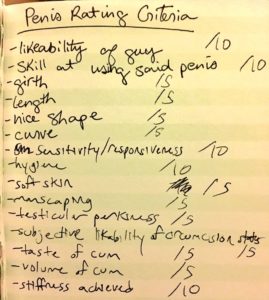
I thought about this again years later when a friend and I devised a rating scheme for penises we had known, featuring criteria like “hygiene,” “soft skin,” “taste of cum,” “testicular perkiness,” and so on. It seemed harmless to me at the time, a hilarious joke perpetrated while tipsy, but upon reviewing it in the light of day, I realized how objectifying it was. What I’d originally conceptualized as a tool for discussing sexploits with friends (“The dick I sucked last night was an 86 out of 100, can you believe?!”) now seemed like a process as cruel and dismissive as swiping through Hot or Not or scoring selfie-submitters on the “Am I Ugly?” subreddit. How could I call myself sex-positive and body-positive if I was literally assigning numerical scores to people’s anatomy? I couldn’t.

There are some cases where rating sexual partners seems fine, or even prudent. Sometimes clients offer public feedback about sex workers they’ve seen (check out USASexGuide for more on that), which can inform prospective johns’ decisions and drive clientele to service providers. There are also always backchannels where women and other marginalized people exchange notes on their dates and hookups with others in their community, warning friends away from abusers and boundary-crossers. These discussions are crucial for keeping people safe who would otherwise have trouble staying safe, because of the unfortunate ways our dating culture and sex work laws are set up. I don’t begrudge anyone for sharing info about “bad dates” and reading other people’s info of the same sort; sometimes these behaviors are the only recourse you have.

But rating people’s bodies and sexual skills is a different thing entirely. Sex is deeply personal, and sometimes embarrassing, and a lot of people have a lot of hangups about it; the same things can be said about our fallible human bodies. It seems unjustifiably cruel to rate people on these criteria in a venue as public as an app or a website, unless they’ve specifically solicited that feedback, like people do on “rate me” forums. (I often wonder if these people are suffering from low self-esteem, or discovering a sublimated objectification/humiliation kink, or both.) In a culture as sex-negative and body-critical as ours, you hardly need say anything at all to fuel someone’s deepest fears and insecurities. Even the most seemingly innocuous criticism can set off a spiral of self-hatred in those of us who are susceptible to this sort of thing, which is most of us.

So I can no longer justify rating and objectifying people (or penises) in the ways I used to. Eradicating sexual shame and encouraging self-love are two of my key goals, professionally and personally, and critiquing bodies and sexualities runs counter to these objectives. This is true not only for other people but for myself: the more you cast a critical eye on how other people look and what they’re doing in bed, the more you’ll tend to judge yourself in those areas as well, perhaps without even meaning to. These mental habits are dangerous, and insidious, and must be actively fought against to be extinguished.

Tell your best friend about last night’s mediocre hookup over drinks, if you like; write in your journal about genitalia that confounded you, if you must. But sharing these judgments online doesn’t really serve anyone, in my view, and it may even contribute to society-wide shame cycles. If you want to create a better world for humans who have sex, one of the best ways to start is to view everyone’s body and sexuality with the same compassion you’d hope they would extend to you.


This post was sponsored. As always, all words and opinions are my own.