“A Song A Week” Challenge: Monthly Recap 10 of 12

Song 41/52: “Go Deeper”

Lyrics:

Breathe in some fresh air and breathe out all your cares and keep breathing
And notice the thoughts that are passing, arising, repeating
And let them all go, because deep down, you know that you’re safe
And inside your mind, you can certainly find a nice place

Let your eyes fall closed if they want to
Feel your spine – it’s strong and it’s got you
Feel your mind melting as it tries not to

Chorus:
Go deeper now
Doesn’t matter how
Just go deeper now
Let your thoughts drift away like a cloud

And if it feels good, then maybe you should let it take you
It’s easier, so just give in and let go of what ails you
Your arms getting heavy, along with your legs and your chest
And if you relax, it is simply a fact that you’ll rest

Who knows where your mind disappears to?
If you call it back, it’ll hear you
But we both know you’re really just here to…

(repeat chorus)


Songwriting diary:

I was deep in trance during a hypnokink scene when the idea entered my mind that I should write a song that is a hypnotic induction. It felt like such an important idea that I said it out loud to my spouse through the fuzzy fogginess of trance, so that I might remember the idea later on. And I did!

Incidentally, a few days before that, I had watched this video about a chord progression that’s apparently super popular in Japanese music but isn’t widely used in Western music (although, notably, both of Rick Astley’s best-known songs – “Together Forever” and the infamous “Never Gonna Give You Up” – use this progression, as does the Silk Sonic banger “Leave the Door Open”). I’d made a note of it incase I wanted to use it for a song at some point. I thought it made sense to use it for this hypnotic song because it’s a progression that never resolves to the home chord of the key, which gives it this strange feeling of perpetual unfinishedness and driftiness, like being in trance.

I wrote some lyrics for the first verse and prechorus, and then sang them over the progression – and then I improvised the chorus after that, and liked how it came out so I kept it.


Song 42/52: “I’d Marry You Again”

Lyrics:

I’d marry you again
Just say when, just say when
Walk down another aisle
Hey, why not? It’s been a while

No need to have it catered
Don’t need a decorator
And tell our friends and family that we’ll see ya later

Just wanna say those vows
We already know how

I’d marry you once more
And meet you out on the dance floor
I’d throw a bright bouquet
Just like I did back on that day

There’s no RSVPing
It’s all about the feeling
Don’t mean to be repetitive, but it is worth repeating:

I’d marry you again
Just say when, just say when


Songwriting diary:

I had tweeted a few days before writing this song about how I still regularly have the momentary thought that I’d like to marry my partner before remembering we already did that. I just love them so much, and wanted to marry them so much before we did it, that my mind evidently still clings onto that as a beloved goal even though it’s already happened. It’s nice.

So, with that in mind, I started improvising words while plucking a minimalistic little ukulele part, and the beginning of this song came out. I built it from there, pulling from online lists of wedding-related tropes and traditions to fill out the rest of the lyrics. It’s a pretty short song (actually it’s the shortest one I’ve done for this challenge), but that’s nice sometimes!


Song 43/52: “Every Morning”

Lyrics:

Is love hard, or has love just been hard before?
My guard is up, but I don’t wanna be guarded anymore

Chorus:
Every morning, you say “I love you”
And every morning, I say “I love you too”
That’s just what we do

My dream love never quite looked the way this does
But my dream, love, was a dream for who I thought I was

(repeat chorus)

Back then, my heart would stop and start
Hot and cold, highs and lows
Then you came ’round; I’m safe and sound
In the now, ’cause I know:

(repeat chorus)

Every morning that I’m in your arms
Is a morning when I thank my lucky stars


Songwriting diary:

I was very frustrated this week at my apparent lack of success in writing a song. It was Friday night and I’d polished up 2-3 songs I’d been writing over the past few weeks, but didn’t really like any of them (one was about tattoos, one about gender and one about impostor syndrome). I wrote in a song earlier this year that “the songs never have to be good; they just have to get done,” and while that’s true, there have definitely been several songs this year that I’ve ostensibly finished but haven’t felt good enough about to include as part of this challenge. I always wanted to push myself to write something better instead, which is what happened this week.

I was messing around with my favorite voicing of the Fmajor7 chord on the ukulele and found a rhythmic way of finger-picking it that was very evocative to me, and so I started improvising a vocal line over it. I had just guested on my spouse’s podcast earlier that day, and one of the things we talked about was how I always imagined I’d end up with a writer, actor, visual artist, or other artsy type when I got older, but mb’s personality and brain are creatively oriented even though they’re not in one of those conventionally artsy fields. (Software development definitely involves a lot of creativity!) So I guess I was in a mood to marvel at how our love story turned out so different from what I’d envisioned all those years and is somehow nonetheless exactly what I needed.


Song 44/52: “Grandmaster”

Lyrics:

I don’t know how you bring out the best in us
There’s people like you, and then there’s the rest of us
I take your thoughts as gifts and as gospel truth
Though my family worries that I might be wasting my youth

But it’s not a waste
To follow you anyplace
And I’ll follow you home, ’cause you’re the only home I know

Chorus:
‘Cause you’re my grandmaster
And I’m falling faster
Than I ever thought I could
And though they insult what they call a cult
I know that your heart is good

I thought I knew myself before I met you
But all that I knew was the lens I’d been looking through
My world is shifting as I absorb your words
You never listen, but somehow I still feel heard

But that’s just your way
And of course, I am glad to pay
For the privilege of being a prisoner you’re freeing now

(repeat chorus)

If sometimes I question some of your lessons
I’m sorry if I’m out of turn
If I understood it, I’d know that you’re good at
Helping us learn what we need to learn

(repeat chorus)

I think that your heart is good


Songwriting diary:

Months ago, the first two lines of this song randomly occurred to me (“I don’t know how you bring out the best in us/ There’s people like you, and then there’s the rest of us“) and I wrote them down in the music folder of my notes app, not really sure what they were about or when I’d ever be able to use them.

At some point I started watching season 2 of The Vow, which is a show about a New York-based cult called NXIVM that I’ve been fascinated by for a while – I’ve seen a couple of documentary series on it and read a book about it. It occurred to me that those lines sounded like something that one of the cult leader Keith Raniere’s followers might have said about him, and then I decided I wanted to write a song from their perspective. It was partly inspired by “Unworthy of Your Love” from the musical Assassins, specifically the part sung by Squeaky Fromme to her hero and lover Charles Manson, and the way she is clearly so brainwashed and taken in by him. “Grandmaster” is one of the names that Keith Raniere’s followers called him, along with “Vanguard.”

I’m honestly not that happy with this song and it feels like one of the only ones I’ve kind of “phoned in,” but I’m also glad I wrote it and I think there’s some good lines in it. Besides which: the entire point of a challenge like this is to generate new songs, some of which I’m gonna like and some I’m not. It’s a useful lesson in releasing perfectionism and just doing what I can do, every single week.
Can We Please Stop Inviting Freud Into Our Bedrooms?

There’s a debate in the sexual sphere that has raged for centuries, and that debate is: Are vaginal orgasms superior to clitoral orgasms? And further: Is everyone with a vagina capable of having vaginal orgasms, or are some of us “doomed” to only have clitoral orgasms – if that – as long as we live?

I find this debate annoying as hell, for three reasons:

  1. It shames a huge amount of people for the way they get off (or don’t get off), which we definitely don’t need more of.
  2. It implies that vulva-bearing bodies are something to be argued about and commentated on by others, when instead we could just listen to those people about how their own bodies work, since they’re the ones who would know.
  3. It’s largely the result of some theories Freud put forth in his day, and he was extremely wrong about a lot of stuff, not to mention frequently misogynist AF.


While I won’t deny that Freud was an important and influential figure in the psychology field, and that some of his ideas had merit, his thoughts on vaginal versus clitoral orgasms were utterly unhinged, and unsupported by any legitimate science I’m aware of. He wrote that part of a healthy transition to adulthood for (cis) women was unlearning the “phallic” desire for clitoral orgasms and instead starting to derive all their sexual pleasure from penetration. He believed that if someone remained “fixated” on having clitoral orgasms, it meant that they were repressed and “infantile.”

I suppose at the time, it would’ve been surprising for a stately male doctor to talk about female sexual pleasure at all – and certainly, his theories laid the groundwork for research that was done later on the G-spot and other sites of vaginal pleasure, hence the worldwide proliferation of A-spot dildos and G-spot vibrators, which I am definitely a fan of. (Freud was multilingual, and one wonders what he would’ve thought of these G-punkt-vibratoren and vibratori punto G if he’d been around to see them.)

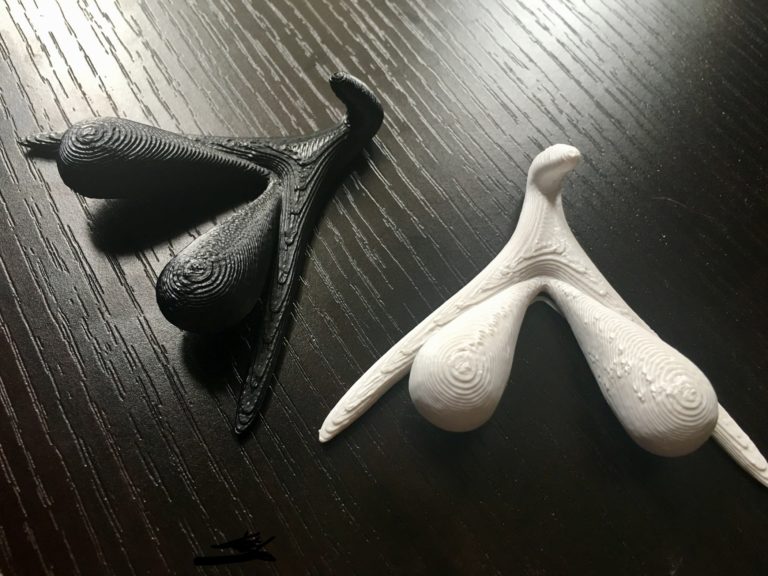
Many theorists have also argued that the G-spot is part of the clitoris – its internal portion, which is much larger than what we see on the outside of the body – and that’s an interesting point that raises a lot of questions about how pleasure and orgasm function. But by and large, I think Freud really fucked us over with his thoughts on sexuality, especially those focused on the clitoris and vagina, and we’re still seeing the effects of that today.

See, anatomically speaking, the clitoris is analogous to the penis. This means that expecting someone to experience pleasure – let alone orgasm – from sex where their clit is completely ignored is every bit as unreasonable as expecting a person to get off without having their dick touched at all. It certainly happens, but only for a minority of people, plenty of whom still find it easier to come when, y’know, their main sexual pleasure organ is being stimulated.

Freud’s narrative of women “aging out of” clitoral orgasms and somehow magically starting to have vaginal orgasms instead is hyperfocused on heterosexual, penis-in-vagina sex. He confabulated upon and romanticized his notion of what penetrative sex “should” be like – i.e. effortlessly, mutually pleasurable for both participants all on its own – instead of listening to people about what that type of sex actually felt like for them. And his views have persevered into a whole new millennium, with mainstream publications and doctors alike still debating clitoral orgasms as if there’s anything less real, less legitimate or less good about them.


I’d love if we could fully shift, as a culture, toward viewing the G-spot and other vaginal erogenous zones as being more akin to the prostate than the penis – since, anatomically and pleasure-wise, they are. Many people love prostate stimulation but still need some dick contact if orgasm’s gonna happen, and this is understood to be normal and expected. The same should be true for folks who require clit stimulation in order to get off, which is entirely normal (I’ve seen various studies estimate this is the case for around 70-90% of people with vulvas).

Of course, the main reason this fact hasn’t gained more traction in the dominant culture is that it forces cis men to contend with the fact that their dick alone isn’t a fantastical orgasm-administering magic wand. It requires them to give pleasure intentionally and effortfully, instead of just assuming it’ll happen as a byproduct of seeking their own direct pleasure through intercourse. A lot of people with vaginas have also absorbed this messaging, such that they may feel “broken” or “high-maintenance” for having entirely normal sexual anatomy and sexual desires. Imagine a cis guy guiltily asking his girlfriend, “Hey, I know we don’t really do this, but would you maybe wanna touch my dick sometime? I think it would feel good for me.” This, sadly, is an exact parallel of the situation many sexually active people with vaginas are in.


But we don’t have to keep perpetuating this paradigm that tells us our bodies are faulty and our desire for pleasure is annoying or immature. We can decide to look at sex in a new way, one that’s actually supported by science and the anecdotal observations of millions of people around the world. We can kick Freud out of our beds, shouting this message back through the centuries: Our pleasure matters, our pleasure is real, and we can and will pursue our pleasure on our own terms.

How My DD/lg Kink Helps Me with Internal Family Systems (IFS) Therapy, and Vice-Versa

Two of the most important concepts I’ve ever learned in my life both go by an acronym: DD/lg, and IFS.

DD/lg, as you probably know if you’ve been reading this site for a while, stands for daddy dom/little girl roleplay, and it’s been a central part of my sexuality since I was about 23-24 (though there were certainly hints of those inclinations in my behavior and fantasies earlier than that). For those unaware, DD/lg is a specific type of D/s (dominance and submission) involving a nurturing, caretaking dynamic between a sub inhabiting a “little girl” role (that’s me!) and a dom inhabiting the role of a wise, nurturing caretaker (that’s my spouse!).

It has nothing to do with incest or (the way I do it) even the fantasy of incest – it’s rare that my partner and I roleplay as a literal daddy and daughter, since that “taboo” aspect is generally not what turns us on about it. Rather, the safety, caretaking, supportiveness and love involved in this dynamic both turn me on and lessen the factors that turn me off (anxiety, body image issues, depression, etc.), creating a psychological environment in which comfort and arousal can both abound.

IFS, on the other hand, stands for Internal Family Systems, a therapeutic modality for healing trauma. IFS is one of the key tools in my current therapist’s toolbox, which is how I got introduced to it – and I’m incredibly glad I did, because it’s truly one of the only things that has actually felt healing and helpful from all my ~16 years of therapy with various different practitioners.

Instead of encouraging you to “logic your way out of” depression, anxiety, and other trauma responses (as in cognitive-behavioral therapy) or to repeatedly relive your traumas aloud as if simply retelling a story could help you heal from it (as in standard talk therapy), IFS teaches you to see every uncomfortable emotion and outsized reaction as a “part” of yourself, who you can have a dialogue with, as if this “part” was an actual human being. In learning to do this work, you can learn to comfort your parts when they need it, instead of letting them flood you with emotion (or “blend with” you, in IFS parlance) whenever you get triggered.

Every “part” represents an earlier version of you who was frozen in time somewhere along the line due to trauma, so a lot of them talk/think/behave much more like children than like adults. But through IFS, you can learn to more and more often inhabit what the model refers to as the Self, with a capital S – the most evolved, integrated part of yourself, essentially the adult who can do the caretaking within your “internal family system” of traumatized childlike parts.

Because I’m a nerd, I’ve supplemented my IFS work in therapy by reading several books on IFS, so I can understand the model better and apply it more effectively in and out of therapy sessions. (The ones I would recommend are No Bad Parts and You Are the One You’ve Been Waiting For, both by the creator of IFS, Dick Schwartz, as well as Healing the Fragmented Selves of Trauma Survivors by Janina Fisher, another IFS practitioner whose work is more explicitly trauma-focused.)

One of the many things I learned from these books is that dealing with so-called “protectors” or “managers” is a big part of the IFS process. These are parts who take on the role of protecting you from feeling the big, deep, scary feelings that can come up when an “exile” (a young part still holding onto old feelings of sadness, shame, rejection and/or aloneness) gets triggered. Protectors and managers might, for example, cause you to fly into a rage when you feel excluded, because anger feels easier and safer than those more vulnerable emotions; they might push you to drink, do drugs, or self-harm in order to block out the exile’s feelings; they might act as an “inner critic,” insulting you and judging you in the hopes that you won’t get hurt as badly if your confidence stays low.

Learning about protectors and managers has been transformative for me; I can recognize now when these types of parts are triggered in other people, which helps me have compassion for what they’re going through and why they might be acting in seemingly odd or irrational ways. But more importantly, I’ve learned a lot more about myself through this lens, like that the parts of me I’ve often hated most – the parts that can be judgmental, mean, and cold – are really just helpless young parts who started acting that way because they didn’t know how else to protect me from feeling sad, worthless and alone.

That being said, I noticed that many of the session transcripts in the IFS books showed a long process of gaining protectors’ trust, convincing them it’s safe to step down from their roles at least temporarily, before the therapist and client would be able to dialogue more directly with an “exile,” the type of young and vulnerable part they’re actually trying to heal. Dick Schwartz emphasizes again and again in his books that if you try to skip straight to a conversation with an exile before first establishing trust with the parts that protect it, havoc could ensue – such as the protectors forcibly taking over, thinking they have no other recourse. (This is why, for example, someone might storm out of therapy after a session or two, saying angrily that it’ll “never work” or it’s a “waste of time” – that’s a protector stepping in and using anger and “logic” as defensive tools to keep the person from feeling the deep, sad feelings of their exile parts.)

What I noticed, in my own IFS work, was that I didn’t have to work as hard as many other people do to keep my protectors mollified. Often I could just dialogue directly with my little exile, maybe after offering some brief reassurance to one or two protectors who came up. I would find myself thrown into the emotional world of a sad ~six-year-old girl, as if she was right there, just under the surface and eager to be engaged with, instead of locked away in some deeply-buried emotional basement chamber. And because I could commune with my exiles relatively quickly upon getting triggered, my healing work – both the in-the-moment process of soothing hard feelings within myself, and the larger-scale project of easing those burdens permanently – seemed to progress more quickly too.

But why were my parts allowing me such close contact with my exiles, without needing to jump through so many hoops and earn so many parts’ trust beforehand? I think it’s because of my experiences with DD/lg.

(I should clarify here that my therapist and I only started seriously diving into IFS work after about a year and a half of working together. Before that, we’d used IFS concepts here and there, but we didn’t really use the IFS process in earnest all that much until I became more interested in it earlier this year. So, I imagine that feeling comfortable with my therapist, and with accessing difficult feelings generally, has also made IFS easier for me than it might otherwise be. And protector parts may, in some sense, have observed the work I was putting into the process and been more willing to “step aside” because of that.)

I think part of why my protectors would “step down” more easily, allowing me more access to my exiles, was that they’d already seen me engage with younger, more vulnerable parts of myself in ways that were healthy, loving and supportive. Through years of doing DD/lg scenes – and just being in a DD/lg dynamic generally – I’d cultivated a strong sense of my “little self,” the version of myself I inhabit when I’m in “little space.” Dick Schwartz talks about a few different key types of intimacy in his books, including “part-to-part” and “part-to-Self” intimacy, and I think my exile has these types of intimacy not only with my partner (who has taken care of her in many different situations, both in and out of scenes) but also with me.

For instance, for years, when I’ve been having a hard time, I’ve sometimes talked to myself as if I was a parent taking care of a little girl, e.g. “Okay, little one, time to clean your room,” or, “We just have to get through this one work assignment and then we can rest, okay, bbgirl?” Over the years I’ve mostly seen this as me “domming myself,” especially at times when I either didn’t have a dom or my dom was physically not present. But in retrospect, I can see that through those interactions, I was cultivating a connection with younger parts of myself – and that in doing so, those parts may have learned to trust me more, and to trust me sooner, than they otherwise would have.

It’s not that I was always a competent adult in my relations with my little self. There were times when I self-harmed, drank too much, went out with people who treated me badly, etc., in an attempt to block out the seemingly unquellable wailing from within (“No one loves me,” “I’m worthless and stupid,” “There is something wrong with me,” and so on). Part of the work I’ve been doing in IFS is making amends with all my parts for the times I was not there for them in the ways they needed me to be. But I do think I had a better-than-average relationship with my exiles upon beginning IFS work, which has made the process feel easier and less scary.

I think one of the reasons I was drawn to DD/lg in the first place, even if I wasn’t consciously aware of it at the time, was that I had this infinitely sad little girl inside me and dreamed that someday, someone would show up and take care of her so well that it would take her pain away. She would no longer have to wonder if she was loveable, or worthy, or good, because someone wise and strong would tell her so. This is what Dick Schwartz calls the search for a “redeemer” – someone who will permanently end your misery and doubt, someone whose adoration finally proves your value in the world, someone who will love you so hard that it undoes all your trauma in one fell swoop.

But the fact is, that person doesn’t exist – even though my spouse is fucking amazing and loves me better and more deeply than I ever could have expected or hoped. No: the best caretaker for my parts, the one who understands them best, the one who loved them first and will love them last, the one who knows what they need and can give it to them day after day after day – that person is, has only ever been, and will only ever be me.

There are times when that feels hard, or impossible; there are times when that makes me angry or sad, because believing in the illusion of an external “redeemer” was easier and in some ways more comforting. But if DD/lg has taught me anything, it’s that patient love and care can be transformative, and can make more room in your life and mind for not only arousal and excitement, but also for comfort, safety, and a sense of wholeness. And just as I took care of myself in the early days of my DD/lg kink by putting a collar on myself and lovingly bossing myself into doing household tasks, so too can I take care of myself now, by being the “redeemer” I need and deserve.

“A Song A Week” Challenge: Monthly Recap 9 of 12

Song 36/52: “Red Lipstick”

Lyrics:

Red lips sink ships, and turn a lot of heads
They stare, but who cares? I like wearing reds
Trends say red may scare the average guy
So I pull out the bullet, and proudly reapply

Chorus:
Give me scarlet, russet, crimson, vermilion
Cherry, berry, carnelian, persimmon
Paint it on me, lay it on thick
Paint it on me, my red lipstick

Boys say they won’t kiss my ruby mouth
They don’t really get what it’s about
Boys say they don’t want to make a mess
But if they want me, they’d want me nonetheless

(repeat chorus)

I’ve got so many shades
For all different days
Some are matte, some are glossy
Some are soft, some are bossy
I’ve got pride, I’ve got power
I am bright like a flower
And if you don’t wanna kiss
Then I guess I’m done with this

(repeat chorus)


Songwriting diary:

I wrote 90% of this song back in May, but set it aside (permanently, I thought) for two reasons. One was that I thought the chorus was too cloying, annoying, and repetitive. The other was that I’d set out to write a song about my love for red lipstick in general, and instead found myself writing about men’s reactions to red lipstick, which felt counter to what I was trying to do with the song.

However, over the months to come, this song kept coming back to haunt me, more than any other musical fragment I’d left behind. I realized that the traits I’d identified as “annoying” or “repetitive” in the chorus actually made it a bit of an earworm. I’ve never been very good at consistently writing “catchy” songs, and I think a huge part of that is how averse I am to being too repetitive (I think this comes from my parents lightly criticizing me for playing super-repetitive Regina Spektor songs on the piano all the time when I was a teen, lol). It was interesting that the very trait that’d worried me about the song was actually part of what made it great.

As for focusing too much on men’s reactions, I realized I could just lean into that aspect of the song and make it into a song that’s explicitly about men’s reactions to red lipstick, and my own reactions to those reactions. There’s no reason I need to write a magnum opus incorporating all my thoughts and feelings on red lipstick; I’ve referenced it in songs before and no doubt will again. Once I accepted that, I had no problem finishing the bridge and therefore finishing the song. Everything but the bridge is more-or-less unchanged from how I originally wrote it back in May.


Song 37/52: “Notice Me”

Lyrics:

I’ve got a poster of your face in my locker
And a collage of all your interviews
Everyone knows that you’re my favorite rocker
They’re always joking that I’m stalking you

I cut your girlfriend’s face out of a photo
And then I glued myself in perfectly
We’ve never met, and so I know that you don’t know
You’re gonna spend your fuckin’ life with me

I don’t mind waiting
I’ll follow you across state lines
To catch the show in Toledo
And see if I can finally make you mine

Chorus:
Notice me from the stage
Notice my lips, my hips, but not my age
And when the curtain falls and the show is through
Notice me, the way I notice you

Sure, there are boys who I could date with less trouble
They’re always laughing in the gym; they clog the halls
But they’re disasters made of swagger and stubble
They’ve got no class, they’ve got no charm at all

I don’t mind waiting
Until I’m 18, if I must
I’ll catch the show in Chicago
And on the Megabus, I’ll think of us

(repeat chorus)

The night gets dark
I watch the stars
No need to wonder where you are
Tonight it’s Milwaukee
Then off toward the Rockies
I’ll follow you far, I’ll follow you far

The night gets dark
I watch the stars
No need to wonder where you are
Tonight, Minnesota
And then South Dakota
I’ll follow you far, I’ll follow you far, so far

(repeat chorus)


Songwriting diary:

One day I walked down to the beach hoping to write some new lyrics, and on my way there, I thought about how much I like songs that start with a vocal line before any instrumentation comes in (the Beatles’ “You’re Gonna Lose That Girl” is an example), and how I hadn’t written a song like that in a while, so maybe I wanted to do that.

Once I found a seat at the beach, I pulled up a random word generator to get 3 words to inspire a song. The words this time were “substitute,” “object,” and “connection,” which made me think about parasocial relationships and how, when I was a teen (and even later), I’d often develop romantic obsessions with actors and musicians because it was easier and less vulnerable than pursuing someone I knew IRL.

I drafted these lyrics, and didn’t decide until about halfway through that it was going to be a song about a girl stalking her celeb crush. When the line about “the show in Toledo” came to me, it seemed right to mention other locations later on in the song, and her stalking him seemed like the most compelling way to do that.

Researching American geography was the most time-consuming part of this songwriting process; I had to figure out a route that made sense but that also included names of regions or cities that rhymed with each other. But it was a fun challenge, and I figured it out eventually!


Song 38/52: “I Could Not Write a Song This Week”

Lyrics:

I could not write a song this week
I could not rhyme, I could not think
I tried and tried to eke one out
But I was overcome with doubt

I could not write a song this week
I could not sing, I could not speak
But that’s just how it goes sometimes
And so I wrote these goofy lines

Some say that writer’s block doesn’t exist; it’s a hoax
And some say it’s par for the course for all creative folks
Whatever the answer, I know a block when I feel one
I’m writing and writing, and nothing I’m writing feels done

I could not write a song this week
My inspiration’s looking bleak
I barely leave the house, then I
Feel stuck, and then I wonder why

I could not write a song this week
I’m wondering if I’ve hit my peak
Should I cut myself some slack
Or just admit that I’m a hack?

Perfectionists find it depressing to make art that sucks
And sometimes I wish that I gave a bit less of a fuck
‘Cause judging my output is pointless – the point’s to have fun
The songs never have to be good; they just have to get done

I guess I wrote a song this week


Songwriting diary:

I was verrrrry writer’s-blocked this week, in part because I had less time than usual to finish my song because I was leaving on a trip to New York on Friday and wanted to finish it before that. I worked on 2-3 other song ideas but none of them were really coming together.

While scrolling back through my folder of song ideas, I stumbled across the first stanza of these lyrics, which I had written several months previous. I’d tucked this idea away, thinking it would be a good failsafe someday if I was ever feeling uninspired – which was exactly what ended up happening. I built from that initial starting point and it was much easier than trying to come up with something wholly new.

It was actually really cathartic to write this song and I feel good about how it came out. It was a useful reminder that sometimes songwriting is more craft than art, in the sense that having a structured songwriting process can help you crank one out even if you feel you have nothing new to say.


Song 39/52: “Existentialist”

Lyrics:

Do you feel the dread
Seeping through the cracks?
Do you read the news?
Do you know the facts?

They say the world is ending soon
Do you know what you will do
When the smoke fills the sky
And we have to wonder why?

Chorus:
What’s the point? What is this?
Quick, we need an existentialist
Where’s the joy? Where’s the bliss?
Please, we need an existentialist
To get us through this

I read a lot in school
On nihilistic angst
When other kids were cursing fate
I was giving thanks

But I still don’t know just what to do
When the world is ending soon
Do we hide and count the days?
Or do we stride into the blaze?

(repeat chorus)

Jean-Paul Sartre, Kierkegaard
Back then, you were avant-garde
Dostoevsky, Friedrich Nietzsche
Now we’d really love to meet ya
Heidegger and de Beauvoir
How I wonder where you are
Lewis Gordon, Al Camus
There’s so much we can learn from you

(repeat chorus)


Songwriting diary:

I was feeling uninspired so I returned to my old friend, the random word generator. One of the supplied words was “philosophy,” a subject I studied pretty extensively in high school and university, so I started wracking my brain for philosophical ideas I wanted to explore in a song. Existentialism has always been my favorite area of philosophy, and I’ve found the existentialist paradigm particularly useful and comforting as our world has descended further and further into fascism, chaos and the climate crisis over the past several years.

I started improvising vocals over chords and sang the lines, “It’s at times such as this/ that I think of the existentialists/ and how they taught us to/ see the power in everything we do.” Eventually I figured out a chord progression that felt suitable and built that initial lyrical idea into something more finessed.

The song was originally much more slow and sad-sounding, but once I’d written it, I felt it made more sense to speed it up and give it more of an unnerved, almost angry feeling. From start to finish, the whole song took about half an hour to write.


Song 40/52: “Tinder”

Lyrics:

Why is every girl on Tinder beautiful?
How do they do eyeliner so flawlessly?
How come all their open hearts are bruised and full?
Profiles packed with doubting and apologies

Chorus:
The world’s not fair
You can see it in this app – it’s all right there
All the pain and all the people who don’t care
If they make you smile or make you come or cry
All I do is swipe and wonder why

Why is every guy on Tinder at the gym?
Or fishing up a trout down at the dock?
Guess I’d rather that than to see more of him
Please don’t send me pictures of your… oh, fuck

(repeat chorus)

Don’t say “hey u up?”
Never just say “sup”
It’s impersonal, so why don’t
You just read my fucking bio?
Don’t destroy the mood before we’ve built it up

(repeat chorus)


Songwriting diary:

I had written the first and second verses of these lyrics several months ago, and found them while I was desperately trawling my music notes folder for something I could salvage into a song. I started singing those lyrics on top of a basic chord progression and then, as sometimes happens, started hearing the next section (the chorus) in my head, as if I was listening to a song rather than writing one. Then I had to write lyrics to fit into the melody and rhythm I was hearing. The bridge was written in the same way.

One of the songwriting books I read this year said that if something was invented within the past ten years, you shouldn’t mention it in a song, because there’s a strong chance it’ll make the song sound dated after not too long. Tinder has been around for just over ten years so I think I’m good 😅 To be honest, I’ve barely used it since I started dating my now-spouse in late 2017, but whenever I check back in on what’s going on over there, I notice similar patterns to how things were when I was a much more frequent Tinder user.

The hardest part of writing this song was figuring out what to say after “Please don’t send me pictures of your…” Some other options I considered were “pet rock,” “Starbucks,” “mohawk,” “dirty sock,” and “Glock.”

“A Song A Week” Challenge: Monthly Recap 8 of 12

Song 32/52: “Amicably”

Lyrics:

I hope your summer brings some sun
And that you spend it with someone
And I hope that when you’re sad
You’ll think of what we had
And say “At least we had some fun”

I hope the drive isn’t too long
I hope your coffee’s nice and strong
And I hope that when you go
You’ll blast the radio
I hope they play your favorite song

Chorus:
I’m gonna miss you
Not gonna kiss you goodbye
I’m gonna cry soon
It feels like somebody died
Because I loved you
And I still remember why

I hope your new place feels like home
And that you won’t be too alone
And if times are getting tough
And your friends are not enough
I’ll always answer when you phone

And now, we head our separate ways
And set our sights on brighter days
But I never will forget
That feeling when we met
And how you set my life ablaze

(repeat chorus)

It was the right thing to do
I think we both know that’s true
You couldn’t just stay

It was the right way to go
Because we both gotta grow
And go our own way
But let me just say:

(repeat chorus)


Songwriting diary:

I was improvising various different lyrical/melodic lines over a simple chord progression, and sang the first two lines of this – “I hope your summer brings some sun/ And that you spend it with someone” – and then built the rest from there. It was one of those magical woo-woo songwriting experiences where it seemed like I was hearing the song clearly in my head and just writing down what I heard.

I have a few friends who’ve recently gone through breakups that were amicable but painful, and I’ve found it inspiring to listen to their stories of letting go of old resentments and arguments and just being happy and hopeful for each other as they both head off into the sunset. That type of breakup has been extremely rare in my life (mine have historically been, for the most part, extremely one-sided and very painful) so it was interesting to inhabit that brainspace for a bit while writing this song.

I think this is the fifth song I’ve written about exes in this challenge… My exes just really haunt my brain. Not in the sense of yearning for them or thinking about them constantly, but more in the sense of: our shared history is always informing my decisions on some level, however indirectly, and I refer back to each of them as mental touchstones in the way I conceptualize my life story, whether in writing or just in my head. So it makes sense that I’m referring to them and considering them in a lot of songs.


Song 33/52: “Nobody Likes Me”

Lyrics:

I wish I’d made a few more friends back in college
It was too hard with all my doubt and anxiety
Instead, I filled my little head with lots of knowledge
And kept it down if anybody talked to me

I didn’t wanna be alone
I didn’t wanna spend my nights at home
I didn’t wanna be that girl
Who stays inside and never sees the world

Chorus:
How do I shake off the feeling that nobody likes me?
How do I go to the party when no one invites me?
How do I banish all the shyness from my mind?
How do I learn that other people can be kind?
But hey, I’m doing fine

My classmates tried to make new friends, oh so sweetly
And I did too, but I was nervous, and it showed
I never let nobody in, not completely
‘Cause then they’d see that I’m a fraud and then they’d go

I didn’t wanna scare them away
I didn’t wanna hear what they might say
I didn’t wanna be so meek
That no one in my class had heard me speak

(repeat chorus)

Don’t worry, there’s a happy ending
I think I’ve finally found the key
Because at last, I stopped pretending
And I went to therapy

I investigated all the shit that makes me wanna hide
And divested from the stresses that were festering inside
Now I’m happier and healthier and I’ve got friends
I hope that’s how your story ends

How do I shake off the feeling that nobody likes me?
How do I get down to healing my jumbled-up psyche?
How do I banish all the shyness from my mind?
How do I learn that other people can be kind?
But hey, I’m doing fine
Hey, I’m doing fine


Songwriting diary:

As I’ve done a few times before in this challenge, I used a random word generator to pick 3 words to inspire a song, and the words it gave me this time were “form,” “college,” and “shallow.” I didn’t end up incorporating either of the other words, but “college” got me thinking about how much I struggled socially and mental health-wise during my time at university. I already have a song that I wrote about anxiety while I was in the thick of it, but hadn’t really written one that looked back at that time in my life from a further-removed vantage point.

The second line of the chorus (“How do I go to the party when no one invites me?”) went through more rewrites than any single line of lyrics in this entire challenge thus far. I had trapped myself by wanting it to rhyme in 3 different places with the preceding line (originally the two lines went, “How do I shake off the feeling that nobody likes me?/ How do I wake up from dreaming that everyone fights me?”) and then I talked to my friend Brent about it and decided to let go of the need for it to be packed with internal rhymes. I’m not Sondheim and that’s okay!


Song 34/52: “The Lube Song”

Lyrics:

Chorus:
Lube, lube, glorious lube
The special sauce of sex
When you’re in the mood
Or when you’re not, it can get you wet

Let’s talk about water-based
It’s available almost any place
It’s compatible with toys and condoms too
So you can do whatever you wanna do

The trouble is, it’ll dry up fast
But add some water and it’ll last
It can cost less than ten bucks a tube
And that’s water-based lube

(repeat chorus)

Let’s talk about silicone
It’s smooth as silk and it makes ’em moan
But silicone toys can be damaged by
This kind of lube; ask a scientist why

It’ll last and last, but it’ll stain your sheets
And just make sure it doesn’t leak
If you spill it, you’re fucked, and you have to move
And that’s silicone lube

(repeat chorus)

There’s one more type of lube I forgot to mention
I don’t have many in my collection
Oil-based lube is a great invention
But watch out – it can cause infection

It’s fine for dicks in most cases
But not for more internal places
Your gynecologist might disapprove
And that’s oil-based lube

(repeat chorus)

Lube, lube, glorious lube
So many kinds to explore
When you’re in the mood
Or when you’re not, you can still use more


Songwriting diary:

I walked down to the beach with my notebook and pen, and sat down to write some lyrics. I hadn’t pre-chosen a topic, but for some reason, after a few minutes of staring blankly into space pondering different ideas, the words “Lube, glorious lube” jumped into my head and I was off to the races.

As I wrote the rest of the lyrics, a bunch of children gathered very close by as their parents snapped a bunch of summery group shots. I have no idea why they chose that location, as I was no doubt photobombing them and they could’ve moved a few feet in either direction and been fine. But now, somewhere, there’s a series of family photos in which a sunglasses-clad stranger in the background is hunched over a notebook writing lewd lyrics about lubricant.

I had a lot of trouble accepting this as a “real song” even once I came home and put it to music. Jokey songs are not really my forte, and I also often feel guilty about “taking the easy route” when I write a song that’s this structurally simple. But I’ve received more positive feedback on this song than for practically any other in this challenge (which probably has a lot to do with my pre-existing sex-positive audience) so I should be gentler with myself about lighthearted songs like this one in the future.


Song 35/52: “Stay”

(Content note: this song deals with themes of depression and suicide)

Lyrics:

The depression’s pressin’ down on you
It can do whatever it wants to
Now you’re stressin’, dressin’ for the day
Wondering: what’s the point anyway?

I wanna hype you up
But I’m worried I’m not too tough
I wanna be your savior
But then I need to be braver

Chorus:
Maybe I’m not really a friend at all
If I can’t stop you and you end it all
Maybe I’m not as good as I say
If I can’t stop you and you go away
Hey hey, hey hey, I really want you to stay
Hey hey, hey hey, I know it’s harder to do than it is to say

When the news is lookin’ especially bleak
And you’ve had a really shitty week
Can I see you and feed you dinner, please
Or whatever else you’re gonna need?

I wanna keep you here
But the path is not too clear
How can I help you through
When I’m struggling just like you?

(repeat chorus)

Hey hey, hey hey, I really want you to stay
Hey hey, hey hey, I just want you to be okay


Songwriting diary:

I woke up in a panic one morning after having a really scary dream where a friend of mine was feeling suicidal and I actually heard him going through with it in another room. After checking the friend’s Twitter to make sure he was actually doing fine (and getting some nice hugs from my spouse, who was staying with me at the time and is very used to comforting me after anxiety dreams, which I have a lot), I took out my journal and wrote the lyrics to this song.

My partner got up to take a shower and I grabbed my phone to make some quick recordings of the melody I heard in my head. It was then that I improvised the “Hey hey, hey hey/ I really want you to stay…” part of the song, which ended up becoming key to its overall structure.

When I sat down at an instrument a few hours later to figure out the chords, I realized that in my head, the song really only had one chord. This is extremely unusual for me and I wondered if I should scrap the whole song because it was too simple. But then I remembered reading in various songwriting books earlier this year that one-chord songs are valid and not even uncommon in the worlds of pop, rock, and blues. So I put together an arrangement in Garageband to spice it up a bit, and I like how it came out!