In Defense of Wearing Socks During Sex

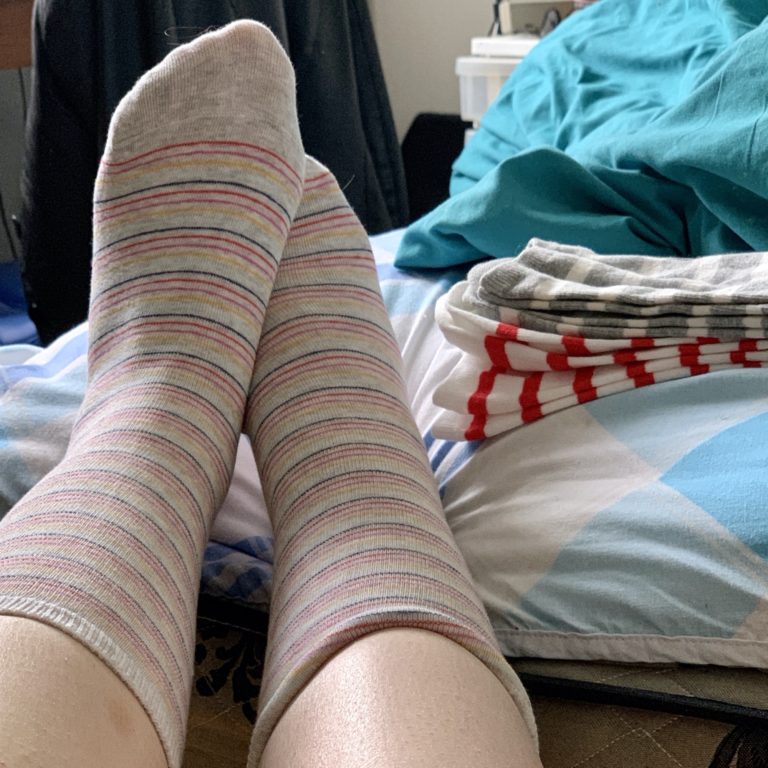
Recently, I asked my partner to write mini reviews of some lewd self-portraits I shot in Agent Provocateur lingerie (yep, I’m needy as fuck) and, in one of the shots, it became evident that I had teamed this very expensive, sexy ensemble with a pair of blue calf-high socks. Rather than do what most people would do and either wish they weren’t there or not even notice them, my partner noted that the socks “show me that you want to come, and they’re the only thing that will be left on you once I get my hands on you.” I giggled, blushed, and nodded. Exactly.

If you’d be mystified receiving a sext like that, let me explain. A study done in 2003 in the Netherlands, on the neural processes that contribute to orgasm, found (among numerous other things) that wearing socks increased female participants’ rate of orgasm from 50% to 80%. Innnteresting.

This makes sense to me, given what I’ve learned from sex researcher Emily Nagoski about how women can be more sensitive than men to the presence of “sexual brakes,” i.e. factors that inhibit sexual arousal both physically and psychologically. (For the record, I’m not really sure how this information relates to trans women or nonbinary people, or whether gender-non-conforming people were included in any of the relevant studies, although my past experiences reading sex research lead me to believe they probably weren’t sampled significantly or at all.) Having cold feet in the literal sense could give women cold feet in the metaphorical sense about having sex, because in some cases it’s a distraction significant enough that it prevents or slows down the arousal process – at least, for me, and seemingly for other women as well. This is likely compounded by the fact that women’s extremities, on average, run colder than men’s. (Again, I assume the research here refers only to cis people, but would be pleasantly surprised if that was not the case.)

In the many years since I first read about the socks study, I’ve cited it to multiple sexual partners when asked why I tend to keep my socks on during sex, or (in the cases of a few foot fetishists) when lustily asked to remove my socks. It’s interesting how just explaining “My feet get cold,” like I used to do before I knew about the science, was typically met with more resistance than the more recent and more airtight “Studies show wearing socks during sex helps with having orgasms.” It’s almost as if… people trust male scientists more than they trust women about women’s own bodies?! Gee, who’da thunk.

I should note here that many people have a legitimate aesthetic issue with the whole idea of socks during sex. Either they think it looks silly and weird (which is their prerogative – I know even ultra-busty pouty-lipped sex dolls would look kinda odd wearing woollen hiking socks and nothing else) or they’re turned on by feet and/or full nudity. When I fuck someone who feels this way, my partners’ orgasms may be inhibited almost as much by me wearing socks as mine would be by me not wearing socks – so I’m sometimes willing to bend my policy and work a little harder for my orgasms, knowing I can wriggle back into my nice warm socks when we’re done. I do, after all, want my partners to enjoy having sex with me!

But luckily for me, I’ve had about as many paramours who loved socks as ones who wanted to ban them from our bedroom. This, I think, can be attributed mostly to my interest in DD/lg – there are a lot of visual tropes within that fetish, and knee-high and thigh-high socks are high on the list for many kinksters. I still remember the time I settled into bed for a nice long phone-sex sesh with a daddy dom years ago: he asked me what I was wearing, I told him “a T-shirt, underwear, and some knee-high socks,” and he moaned/growled/grunted with such ferocity that I knew I had made the right choice even though he couldn’t even see my outfit.

Sometimes when I talk to other women about wearing socks during sex – and, yeah, my life is sufficiently weird that this topic does come up in conversation with friends sometimes – they seem slightly mystified by my decision to put my comfort first in a sexual scenario. I think this is sadly emblematic of our sexual culture. Mainstream porn, for example – while I adore much of it and think it is necessary and important – is full of messaging which suggests that hot sex and comfortable sex are basically mutually exclusive, especially for women (can you IMAGINE doing reverse cowgirl, while standing, for 20+ minutes straight?! I simply cannot). And indeed, there are some sex acts I enjoy greatly which could not be considered “comfortable” by any stretch of the imagination (getting paddled and getting throat-fucked come to mind), so it’s not like discomfort is incompatible with arousal for me. But for some reason, socks are one place where I draw a line. I’m rarely up for being uncomfortable in this particular way even though I’ll happily be uncomfortable in various other ways during sex from time to time.

I will say, too, that this has sometimes been a litmus test of sorts for how a new partner reacts to boundary-setting or mid-bang communication. Are they really so committed to their porn-borne sexual scripts that they’re going to insist on full nudity at the expense of my comfort? Are they really going to argue with me about this perfectly reasonable boundary I have set for my own body? Or are they going to say “Huh,” shrug it off, and move on like nothing is wrong (because nothing is)?

Despite being a foot fetishist, my current partner is so devoted to and interested in my pleasure and my orgasm that they’ll often encourage me to keep my socks on during sex. And this makes it all the more delicious for both of us when – after giving me a partly socks-enabled orgasm or two – they crawl down my body, rest their hand gently on my ankle, and ask so so sweetly, “May I take these off and look at your feet?”

Respecting sexual partners’ boundaries is so, so important, even if those boundaries don’t totally make sense to you. Every time a partner respects one of my boundaries without question, it becomes easier and more fun for me later on to bend my more flexible boundaries in the name of pleasure. Heeding my “no” now is likely to get you a “yes” later, for something else. I’m glad science exists to back me up when I set this particular boundary, but the truth is, I shouldn’t need a scientific citation to state what I want and have that be respected.

So when my partner compliments the socks I’m wearing in nudes ‘n’ lewds, I know it’s more than just a compliment. It’s an affirmation that my choices are valid, my boundaries are important, and I am beautiful regardless of which clothes I do, or don’t, remove.

5 Underrated Measures of Compatibility

I’m not sure I really know anything about compatibility. I’ve only been in 2-3 relationships I would consider “long-term” in all my 27 years, so I’m maybe not the best person to advise you on what works. But I do know a lot about what doesn’t work, having lived through my fair share of disastrous relationships destined to fail. (Bleak? Yes. True? Also yes.)

You hear a lot in sex/dating media about well-known measures of compatibility: sharing similar interests, for example, or being able to make each other laugh. But here I present to you, for your consideration, 5 measures of compatibility that I think are under-discussed, rarely understood, and deceptively important…

Sexual desire style. Disregard this point if sex isn’t part of your relationship, but if it is: have you heard of responsive desire? Brought into popular consciousness through Emily Nagoski’s excellent book Come As You Are, responsive desire is a way of wanting sex that differs from our culture’s usual “lightning bolt to the genitals” understanding of how the sex drive works. “Instead of emerging in anticipation of sexual pleasure, like spontaneous desire,” Nagoski explains, “responsive desire emerges in response to sexual pleasure.” In other words, instead of wanting sex and then going to get it, folks whose desire is responsive often need to encounter sexual stimuli (dirty talk, porn, erotica, sexual touching, etc.) before they become aroused and start wanting sex.

Learning about this was revelatory for me, and many other folks who may have felt broken for seldom craving sex out of the blue. But here’s where compatibility comes in: I prefer to date and fuck folks whose desire style is closer to the “spontaneous” end of the spectrum, because when I date another responsive-desire person, sexual initiation can feel like the dreaded “Where should we go for dinner?” conversation: “Where do you want to go?” “Well, where do you want to go?” A person whose desire is spontaneous, to continue the metaphor, is likelier to say, “Here’s where I want to go. What say you?”

This is not to say you can’t date another responsive-desire person if that’s how you operate; it may just mean you both have to take a more proactive approach to purposely arousing each other (and yourselves) rather than waiting for someone else to bestow arousal upon you.

Decisiveness vs. indecision. Speaking of the “Where should we go for dinner?” conversation… I am a chronically indecisive person in many areas of life, partly owing to just lacking confidence in my own choices and tastes. It’s no secret that I’m submissive, so I like to be bossed around in bed, but I also find it affirming to be (consensually) bossed around by certain people outside of the bedroom. Weirdly, it’s a way they can show me they care.

My boyfriend, for example, is the type of person who loves making plans and being in charge of things. When he does a good job of this, he feels accomplished and proud. So he’s a good match for someone like me. When he plans a date night for us – makes reservations, gets us there on time, helps me choose what to order – I feel deeply loved and taken care of, while he enjoys the satisfaction of knowing he took care of me in that way.

Compatibility is about more than what you can do for each other; it’s also about what you enjoy doing for each other. If I was dating someone who was willing to make these types of plans but found it tiresome, each outing of this type would just drive us further apart and foster resentment – but because my partner enjoys making the exact kinds of decisions I don’t enjoy making, this interaction just brings us closer every time it happens.

Communication preferences. You’ve probably heard of the love languages. It’s an oversimplification of human psychology, perhaps, but it’s also a useful framework for understanding how to communicate with your partner.

I’ve dated people before whose love language was quality time, or acts of service, or gifts – and while all of those things are lovely, my most significant love languages are words and touch, so if I’m not getting those things in abundance, I don’t feel fully loved. It is possible to adjust your communication style to better suit a partner who differs from you in this way, but not everyone is willing or able to put in the psychological and logistical work required to make that shift.

Along similar lines, I’ve dated people before who didn’t like to text a lot when we were apart, or who answered my carefully-crafted messages with monosyllabic apathy, and that doesn’t work for me either. Communication is a huge part of what allows relationships to function smoothly and healthily, so if you and your partner have incompatible communication styles or preferences, it could become a major sticking point if it hasn’t already.

Coping strategies. What do you do when you’re stressed, sick, or depressed? How do you communicate at those times? What do you tend to want, need, and crave at those times – and what do you absolutely not want? Would your ideal partner give you support, or space? Would they bring you soup and sympathy, or would they back off and let you do your thing in peace?

While it’s useful to ponder these questions before they become relevant in a new relationship, often you won’t know quite how your stressful periods interact with your partners’ until you actually live through one together. It can be helpful to specifically ask for what you want – “Can you come over and cuddle me in silence for a while?” or “Sorry, I just need a few days to sort this out, but can we get dinner on Friday?” – but, depending on your partner’s own stress levels at that time, they may or may not be willing or able to give you what you’re asking for.

I learned this lesson the hard way when I had a boyfriend who suffered from intermittent depression, like me, but who needed altogether different things than I did when he was depressed. At those times, he craved emotional distance, lots of time alone to work through his feelings in private. He didn’t want kisses, or cuddles, or sex. But when I’m depressed, I usually want to be with the person/people I love, and get as close as possible, through both physically and non-physically intimate activities. Obviously, when we were both going through a tough time, we found each other pretty frustrating! Complementary needs in this regard are something I look out for now when assessing my potential compatibility with someone, because they can really make or break a relationship.

Relaxation activities. They say you don’t truly know whether you’re compatible with a partner until the two of you travel together. I think this is a good piece of wisdom, not only because travel can be stressful (see above) but also because vacationing together lets you see how your partner prefers to relax – which may be altogether different from how you prefer to do those things.

If you like to unwind by reading a book on the beach, but your partner wants to do the entire museum circuit, you may not be the best match – unless you’re able to happily go your separate ways and reconvene later on. This principle also applies to relaxation in your day-to-day, not just on vacation. If you need quiet time to recharge after a long day, but your partner needs to verbally unpack everything that happened to them and/or dance the day’s stress out at a club, you may not be the best fit – unless you can find ways to each get what you need, separately or together, without stepping on each other’s toes too much.

I often fondly reminisce on a Montreal trip I took with an adventurous, excitable friend. I expected her to drag me to historic sites and famous bagel shops – and she did, some of the time – but one afternoon, I told her I needed to recharge my introvert batteries and she suggested we go to a café with our books and journals and just sit in silence for a few hours, sipping coffee and chilling out. It was one of the most blissful experiences I’ve ever had on a vacation, and all because we were able to find common ground in how we chose to relax.

Which measures of compatibility do you consider important in a partner or friend?

5 Questions to Ask Your New Kink Partner

A vanilla friend once asked me, when I gushed about how well my new dommy beau’s kinks fit with mine, “Isn’t that the point of identifying as dominant or submissive? So you can easily find someone who’s compatible with you?”

Ha. Easily? That’s a laugh. While I am indeed a submissive – and a damn good one, if I may say so – that doesn’t mean I automatically jive with every dominant who crosses my path. Even setting aside more basic factors like attraction and harmonious personalities, we might not work well together kinks-wise because there are so many different ways to be dominant or to be submissive. If I want to be nurtured but you want to degrade me until I cry, maybe we’re not gonna work out. If you get off on heavy sadism and my pain tolerance is only so-so, we might have to part ways. If the names and words that light your fire are ones that squick me out, maybe we should quit while we’re ahead.

While there’s no foolproof and thorough way (in my view) to assess compatibility quickly, there are certainly ways you can help speed it along. With that in mind, here are 5 questions you can ask your new beau (and answer yourself, too) to figure out whether your approaches to kink could work well together – for an evening, a fling, or maybe even for the long haul.

1. What kinds of feelings do you like getting from kink?

When you’re in the midst of a kink scene, do you like feeling adored, appreciated, accomplished? Or do you prefer to feel overwhelmed, overpowered, and owned? How about degraded, dejected, or dismissed? (More great feelings words on Bex’s Yes/No/Maybe list.)

Knowing this about a potential (or current) kink partner can help shape your scenes. I’ll take a very different approach when submitting to a dom who appreciates quiet obedience, for example, versus a dom who likes a little bratty resistance. Likewise, if a dom thinks I want to feel used and put down, they’re not going to be able to give me the type of scene I actually tend to want, which involves me being cherished and coddled. Figure out your desired feelings first, and then you can start to figure out everything else.

2. What does it look like when you’re enjoying yourself? What about when you’re not?

As a sub, I giggle when I’m enjoying myself – but I know other subs whose mid-scene giggles might mean they’re uncomfortable and don’t know how to say so. I know people whose stony silence might mean they hate what’s happening, and people who only go silent when things are feeling really good. I know people who kick and scream when they’re taken past their pain limits, and people for whom that’s just a sign that the scene is going swimmingly. It’s important to know how your particular play partner responds to both good and bad stimuli, so you know when to slow your roll and when to hit the accelerator. Of course, you shouldn’t rely only on these cues – it’s still important to have (and heed) a safeword, and perhaps a green/yellow/red check-in system or something similar – but they’re crucial to know, nonetheless.

That doesn’t only hold true for subs and bottoms, either. Doms and tops also have “tells” for when they’re enjoying a scene and when they’re decidedly not. A bonus of articulating these signs to a partner is that you get clearer on them yourself. I never used to notice, for example, that my ankles would cross together protectively when I was nearing a pain limit, until a partner asked me to list and explain some of my nonverbal signals. Being more aware of your own body and responses is always useful!

3. Has anyone ever safeworded with you before? What happened?

This is one of my favorite screening questions for new doms, because it shows me quickly how they handle consent in scenes and to what extent they respect their partners. A bad or dangerous dom will tend to get defensive when asked this question – “Of course no one has ever needed to safeword with me!” – while a good dom who’s been around the block will likely have at least a few stories to share. (I’m sure you could learn a lot about a sub by asking them this question, too.)

Pay attention to how they talk about the person who safeworded (affectionately? dismissively?) and what they claim to have done after the safeword was said (hopefully they tried to give the person what they needed, instead of reprimanding them or abandoning them). Notice, too, what their general attitude on safewording seems to be. If they view it as a wimpy cop-out that should best be avoided, rather than a vital communication tool in any encounter, maybe you should steer clear.

4. What are some edges you’re interested in pushing?

These malleable edges are also known as “soft limits”: things you aren’t interested in doing, with most people or in most circumstances, but that you might be open to if the right situation and partner came along for that particular thing.

For example, I don’t want to feel like some douchey bro’s blowjob machine, but with a compassionate dom who I trusted and loved to please, having my mouth used in an objectifying or degrading way could be fun. Maybe your partner’s been curious about knife play for ages but has never had a chance to try it out. Maybe they’re a dom who’s curious about subbing, or vice-versa. Whatever it is, you don’t have to push that edge immediately or at all, but it’s good to at least know about it, so you can perhaps start to work toward it together.

5. What kind(s) of aftercare do you need?

If someone is new to kink – or hasn’t done it in a while – they may not know the answer to this. But they probably have at least some idea. Common elements of aftercare are cuddles, compliments, and snacks – but of course, these don’t work for everyone.

I get nervous doing scenes with new partners who I haven’t discussed aftercare with yet. While most kinksters seem to know intuitively that aftercare is important, it’s hard for me to relax and have fun if I don’t know that I’ll be properly taken care of when I’m too subspacey to articulately advocate for myself. So it’s best to have this conversation before it becomes relevant, so both of you know you’ll be able to get what you need.

What questions do you like to ask new kink partners before playing?


This post was sponsored. As always, all words and opinions are my own.

Intimate Intercourse: Hypnokink (Part 3)

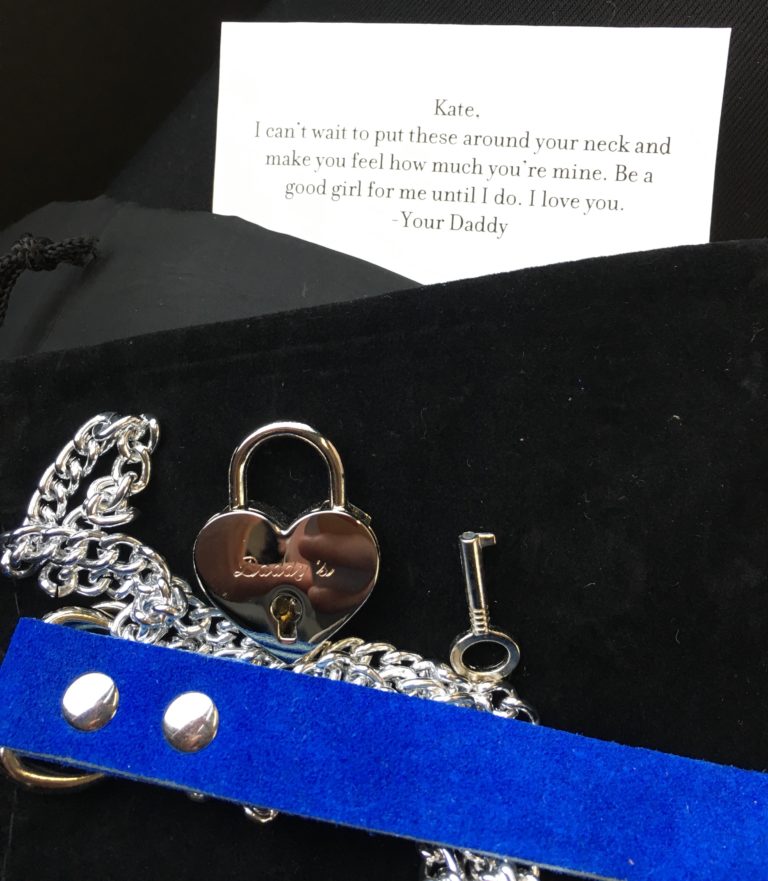
Hello again! Welcome back to Intimate Intercourse, a series where I interview my boyfriend/Sir/daddy, who goes by Super Sleepy Dude, about various topics related to sex and kink. This week we’re discussing hypnokinkThis is the final part of a 3-part interview; you can read part 1 here and part 2 here. In this instalment, we discuss combining hypnosis with other kinks, how to ensure ongoing consent in a hypno scene, hypno aftercare, resources we recommend, how to cultivate a hypnotic voice, and the role intoxication plays in our hypno play. Enjoy! Content note for this post: hypnosis (obviously), impact play, Daddy Dom/little girl roleplay, sleepy sex, bondage, axe violence (!), and marijuana/intoxication.


Kate Sloan: So – we’ve been talking about this a little bit already, but – how do you like to combine hypnosis with our other kinks? I know we’ve combined it with impact a fair bit…

Super Sleepy: I think the best combination that we did with impact was pretty recently. You had said that impact I was giving you was already making you feel trancey – because, as you alluded to earlier, flow state, subspace, trance, they’re all names for gradations of the same feeling, the same state. And so, sometimes the brain recognizes it as one or another one or whatever, but it’s kind of the same. It’s a hyperfocused state where a lot of stuff fades away and things feel really good, and like they’re working. And the particular thing that you’re focusing on, and the particular emotional valence of it, are dependent on the context. But you were feeling like the impact I was giving you over the phone was pretty trancey. Maybe it was the rhythm, maybe it was just your mood that night, but we decided to lean into that and actually use that impact as an induction. I think that worked out really well, and I’m really looking forward to doing that in person, where we use impact as a way to make you really sleepy.

KS: We also combine hypnosis with DD/lg a lot, but not super overtly; just kind of ‘cause our relationship is DD/lg.

SS: Yeah. Daddy often wants to make his little girl sleepy before bedtime, and then often fuck her, maybe while she’s somewhat unaware of that. You know?

KS: [giggling] Mmhmm! A lot of people are concerned about consent with hypnosis…

SS: Same.

KS: So, you do the pre-scene negotiation, but how do you ensure consent when the scene is actually going on?

SS: Ongoing consent. Yeah. This is one of the toughest things to do. It’s similar to ensuring ongoing consent in any case where you’re gagging somebody or you’re taking away some obvious way that they’re able to show that – blindfolding them or putting a bag over their head or a mask or whatever. The best practice, and what I try to do, is phrase the suggestions with safeguards. So, your trance trigger, for instance, originally and every time it’s reinforced, is phrased like: “You will get sleepy and trancey and go into trance for me, as long as you’re in a place where it’s safe to do that.” If you’re not, you don’t have to do that, and also, if you don’t consent, then it’s obviously not safe, so you can opt out of it. The other thing you can do is, you can talk to somebody that’s in trance. They won’t quite be the same as if they’re in the negotiation mode, or fully aware of what’s going on. It’s sort of like talking to somebody that’s in subspace; you gotta phrase things very clearly, and you have to be aware of the differences in their mindset, but you can – while keeping somebody in trance – do check-ins, as long as you know how to talk to them about what you’re checking in about. So I do that a lot.

KS: What would be an example of that?

SS: An example of that would be, if you had somebody in hypnotic bondage, you could say something like, “It seems like you’re feeling really good right now, and that not being able to move is making you feel happy and comfortable. Is that right?” And if you hear an enthusiastic “yes,” that’s great. If you hear a hesitation, that’s when you might want to either press further or bring the person out of trance, because you’re not usually gonna get a “no” in that case. You’re using hypnotic language, and the person’s in trance; you wanna listen for the tiny hesitations. We’ve been in a lot of scenes where you’ve hesitated, and usually it’s like, “My phone is falling,” or “I need to charge my phone,” or whatever. It’s not a gigantic consent issue, but there’s these tiny hesitations, which, in a normal scene, would maybe be much easier to hear; you gotta listen a little bit harder in a hypno scene, though.

KS: And we established a safeword, which I don’t even remember now…

SS: Purple!

KS: Yeah? Okay. I think we should have it be any color that isn’t red, green, or yellow, because the fact that I couldn’t remember it now makes me worry that I wouldn’t remember it in trance.

SS: Sure, yeah.

KS: So that was just supposed to mean “I need to talk to you, so I need you to take me out of trance so I can talk to you.” I don’t remember what happened that prompted that, but there’s occasionally been stuff like, one of my roommate’s cats is in my room and I have to let her out, or…

SS: Yeah, there’s stuff like that, or, do you wanna talk about the time that you had an abreaction, like a really scary thing happened in a visualization?

KS: Yeah. You were making me picture going down in an elevator, as a deepener, and you had the elevator door open on a few different floors, and there was no reason for this to happen – I hadn’t been watching a scary movie or anything – but I saw this nun dressed in head-to-toe white on one of the floors, with the habit over her face, she had no face… It was really scary!

SS: That’s creepy, yeah.

KS: It was some American Horror Story shit. And then, when I got all the way down to the bottom of the building, I still felt like the nun was in my room, holding an axe over me. I couldn’t open my eyes, ‘cause I was in trance, so I couldn’t check to see if there was actually a nun in my room. But yeah, I got really freaked out, and I didn’t know how to communicate that to you, ‘cause that’s quite complicated and weird, and you were trying to do a sexy thing, and I was just panicking. Pretty weird.

SS: Yeah. Stuff like that can happen, especially if you’re having people visualize situations and you don’t control very tightly what you’re telling them. It’s good to have ways to communicate that, even if the person is in trance. Reminding people who are in trance that their safewords will still work, that they can still say them… I would be hesitant to ever take away somebody’s ability to talk in a hypno context. To make somebody unable to talk – that’s possible, but then you have to figure out alternate safe-signals, and that’s a pretty risky thing to do.

KS: Especially over the phone, yeah.

SS: Over the phone, don’t do it. Like, just don’t do it. I would never do it. One more thing on this: one thing I always worry about is getting disconnected. This comes from, I think, my Omegle experiences, also, because I would trance people on Omegle and they would disconnect at very random times, probably on purpose sometimes, probably accidentally other times – whatever, internet issues, people refreshing the page or whatever. But having somebody in trance and not being able to bring them up correctly and give them proper aftercare is not good. It’s not good for anybody. It’s not good for the top, it’s not good for the bottom, it’s not good for the brain, really. So, even though the physical risks are usually pretty low – the brain will realize that’s happening and usually wake itself up and it’s fine – it doesn’t feel good. So I’m always worried we’ll get disconnected, and it has happened a few times, but usually not in the middle of a situation where you’re bound and wouldn’t be able to answer the phone. That’s the times I worry about it the most.

KS: Yeah. I think it would be okay.

SS: It would probably be fine.

KS: Yeah. What does hypno aftercare look like?

SS: Hypno aftercare is pretty verbal, in my experience. Touch, if you can do it, but if you’re long-distance, it’s pretty verbal. It’s a lot of making sure the person is actually awake, if they want to be. Sometimes we do hypno and then you immediately go to sleep – I hypnotize you in order to make you go to sleep for real – but in the cases that it’s not like that, and we’re doing aftercare, you wanna make sure the person is awake and able to go about their night or their day in a way where they’re not gonna hear suggestions in the world and still feel really suggestible. You wanna get them back to a rational baseline for their personality, and you want to uninstall any temporary triggers and make sure that you leave them in an operable state.

KS: Yeah. I actually don’t really like the times when you put me to sleep and then we immediately go to sleep. I’m only just thinking about this now. Because what ends up happening every single time is, the phone going dead startles me, and then I wake up and I’m alone and we haven’t done aftercare, and I’m really sad.

SS: Okay, so let’s not do that.

KS: Yeah. ‘Cause it’s also subspacey me feeling like a failure because I didn’t do the thing I was supposed to do. So it’s just a lot of bad feelings.

SS: Yeah, let’s not do that anymore.

KS: Yeah. Anything else we didn’t talk about?

SS: Resources!

KS: Yeah. ‘Cause we’re not doing any kind of introductory or instructional stuff in this interview, really.

SS: Right, yeah. Go read Mind Play by Mark Wiseman. Hypnotic Amnesia by Pynch and Lee Allure. If you’re in a big city, there’s probably either a conference or a regular hypnokinky meetup on FetLife that you can find. If you’re not, go to one in a big city. There’s a lot of hypnokinky people out there. A final thing on resources: the Erotic Mind-Control Story Archive is really great, and there’s tons of great stories there, and you should read them and enjoy them, but what they say is kind of true – it’s erotica, it’s porn, it’s not how you should actually conduct yourself, in terms of actually running real hypno scenes. So, read it, enjoy it, jerk off to it, but if you actually wanna do stuff, there are practical resources that I just mentioned.

KS: Oh, I wanted to ask you about your voice.

SS: [sexy voice] What about it?

KS: Have I asked you about your voice in every interview we’ve done for this series?

SS: Maybe.

KS: Tell me about the hypno voice. What’s up with the voice? What do you do differently?

SS: I don’t know! I don’t know. What do I do differently, little one?

KS: I don’t know. I thought you would have a description on tap.

SS: People who do a lot of hypnosis develop a voice, generally, to do it with, that is different from their normal voice. It’s useful to do that because, if you want to get somebody trancey, you can just drop into that voice and they’ll start going there right away. [deeper, slower voice] Like, if I start talking to Kate like this, she’ll probably already start to blink, and get a little bit sleepy, and that’s okay… [regular voice] Open. Good. So… I have a voice! It’s useful! But I don’t know how to describe it, really, ‘cause it’s sort of just a slower, more calming version of my voice. You know?

KS: Yeah. I like it. Oh, one more thing! You often have me smoke weed before we do hypno stuff, because we found that it makes me more suggestible and go into trance more easily.

SS: We did. Most people don’t find that. Most people find that alcohol and drugs make them less susceptible to hypnosis, not more, because for a lot of people, it makes it harder for them to focus, or it dulls their senses or whatever. So that’s a very individualized thing, and I would say, if you do stuff with drugs and also hypnosis, it’s partner-by-partner and you gotta experiment. We have found, in our very particular case of you being a subject, that it generally makes it easier for you to drop for me.

KS: But there are limits. If I get too high then that’s not always good. Then I can’t focus.

SS: Right, exactly.

KS: That’s all my questions, unless there’s something else you wanted to talk about. I feel like you just wanna go trance me right now.

SS: Mmhmm. I do. One other thing is, the common misconception is that hypnosis is mind control; there’s a lot of media that reinforces that idea. And it’s not. It’s giving someone suggestions that they are consenting to. On the flipside of that, there’s another misconception, which is that you can’t make somebody do anything in hypnosis that they don’t want to do, which a lot of abusers use in order to cover up consent violations, and is also not true. So the consent ethics are complicated, as they often are, and I would encourage people, if they’re trying this for the first time, to go into it with really highly highly negotiated scenes.

KS: Yeah. I think of it like subspace, in the sense that you can also make people do things they don’t wanna do, of their free will, in subspace, because that’s just how abusive dynamics work sometimes, and I don’t think it’s any different.

SS: Yeah. It’s a very good analogy. I think that’s basically right. And so you should treat hypno scenes like kink scenes, in terms of consent, and you shouldn’t do what the non-kinky erotic hypnosis community does, which is, like, ignore everything that the kink community has learned about consent negotiations and stuff.

KS: Yup. I very much appreciate that you’re always very careful about that stuff.

SS: Yeah.

KS: Okay. Thank you!

SS: You’re welcome, little one.

KS: I love you.

SS: I love you too.
Love and Lust: The Universal Language?

At the top of the Palatino in Rome.

Where did the fantasy first arise in my life of having sex with someone who doesn’t speak English and whose language I do not speak? Was it the Love Actually subplot where a British befuddled Colin Firth has an awkward-yet-romantic dalliance with his Portuguese housekeeper Aurélia? Was it the lesbian erotica story I read in some anthology whose name has been lost to time, where an English-speaking tourist meets and seduces an exclusively Spanish-speaking woman at a nightclub while on vacation? Did I see it in porn somewhere and internalize it? How did this become one of my formative ideas of the magical heights of romance?

Though the lingual disconnect is played for laughs in Love Actually and spun into lusty wonder in the erotica story, it obviously poses many real-life logistical issues that could prove unsurmountable. These romanticizing tales want us to believe love (or lust) is the ultimate human “language,” that it can overcome cultural barriers and connect us even in the face of communication obstacles. This narrative erases and harms asexual and aromantic people, and it isn’t even accurate. Humans developed language for a reason: we need it. Sex and romance are nebulous enough already, even when you do speak the same language, because often these feelings are difficult to put into words, even for yourself. Being reduced to gestures and facial expressions when trying to explain your feelings to someone seems like hell, especially for someone like me who thrives on words of affirmation.

Not to mention: in our recent (and less recent) cultural conversations about consent, it’s become clear that verbal consent is the gold standard for ensuring a sexual encounter is on the up-and-up. There are certainly ways to acquire and give consent non-verbally, and arguably most consent is given and gotten in this way, but I think it only works because it’s usually combined with some verbal element. Sure, you can read someone’s body terrifically, but at some point you’re probably gonna ask, “Is this okay?” or “You like that?” or “You want more?” and it’s hard for me to imagine navigating sex safely and responsibly without the ability to even do that.

That said, I’d be lying if I claimed this fantasy never crosses my mind anymore. Like many fantasies, it’s unfettered by logistical considerations when I ponder it in private moments. I can imagine that me and this other person can read each other’s bodies perfectly, almost like we’re reading each other’s minds, without needing a common language to know each other’s most intimate wishes. Afflicted by anxiety, my brain often floods with worrying words during sex – the very activity that’s said to steal your words away and quiet your mind – so it’s, in some ways, a comfort to consider sex wholly without words. Who would I be, and what would I feel, if I could quiet my mind and focus only on my body and someone else’s?

I think another movie, Before Sunrise, fanned the flames of this fantasy for me. In it, two travelers – who are from different continents but both speak English – have a chance meeting on a train zooming through Europe and embark on an impulsive all-night adventure in Vienna. I’ve longed to go to Vienna since seeing this film; the landscapes and locations strike me as achingly romantic. And because I’m a perv, I imagine that if I met an attractive German-speaking local there, we’d somehow flirt non-verbally, kiss under an Austrian sunset, and wander into a sex shop or Fleshlight store together to look at the “mini vibratoren” that we would then use in a majestically-lit hotel room later on.

Verbal communication is pretty much the only type I’m good at – and sometimes not even that – but somehow, in my fantasy, I get by just fine without it. And there’s a lot of kissing and orgasms and maybe some giggling atop a giant Ferris wheel.

Do you have any fantasies that you know wouldn’t work in reality?


This post was sponsored. As always, all writing and opinions are my own.